You can rank first on Google and still lose the click. On many searches, an AI Overview now sits above the blue links and answers the question before anyone scrolls.
That changes the goal. Ranking is still the entry ticket, but the prize is a link inside the answer itself, and Google picks those links by its own rules.
This guide shows you how to earn that spot, step by step, using Google’s own documentation and the best citation studies available. It also covers measurement, because Search Console reports AI visibility differently from normal clicks.
So how do you show up in AI Overviews? The same way you show up in Google: by being eligible, relevant, and the most useful source for part of the answer.
In practice, that comes down to five things:
- Your page is indexed and allowed to show a snippet.
- Your site is still set to “include” in Search Console’s Search generative AI control.
- Your page ranks for the searcher’s query, or for one of the related “fan-out” queries Google runs behind the scenes.
- Your page states a clear, self-contained answer that Google can link next to a specific claim.
- Your page or brand adds something other sources don’t: first-hand data, real experience, or a clearer explanation.
Google’s AI optimization guide says there are no extra technical requirements and no special markup for AI features. Anyone selling a secret AI switch is selling something Google says doesn’t exist.
No one can guarantee inclusion. Google says indexing and serving are never guaranteed, and AI Overviews only appear when Google decides they add something beyond the classic results.
What AI Overviews Are, and Why They Matter Now
AI Overviews are AI-generated summaries at the top of some Google results. They answer the query and link to supporting pages.
The scale is hard to ignore. At Google I/O in May 2026, Sundar Pichai put AI Overviews at more than 2.5 billion monthly users and AI Mode at more than 1 billion, according to Google’s I/O 2026 recap.
Google has also been joining the two experiences together. Since January 2026, people can ask a follow-up question directly in an AI Overview and continue in AI Mode with their context intact. At I/O 2026, Google made Gemini 3.5 Flash the default model in AI Mode.
How Often AI Overviews Appear (and Why Studies Disagree)
Prevalence numbers swing wildly because each study tracks a different set of keywords.
| Study | What it measured | AI Overview share |
| Pew Research Center (March 2025, real browsing data from 900 U.S. adults) | Share of real Google searches | 18% |
| Semrush (10M+ keywords) | Broad keyword panel | 6.49% (Jan 2025), 24.61% peak (Jul 2025), 15.69% (Nov 2025) |
| Conductor (21.9M queries) | Enterprise panel | 25.11% |
| BrightEdge, “AI Overviews at the One-Year Mark” (Feb 2026) | Tracked commercial-vertical queries | About 48%, up from about 30% in Feb 2025 |
What this means for you: Ignore the headline averages and check your own keyword set. Industry matters far more than the overall number.
BrightEdge’s February 2026 report put AI Overviews on 88% of tracked healthcare queries (up from 72%), 83% of education queries (up from 18%), 82% of B2B technology queries (up from 36%), and 78% of restaurant queries (up from 10%). Local queries sat at only about 7%, and shopping-style queries stay much lower in Semrush’s data.
Query wording matters too. Pew found AI summaries appeared far more often on searches phrased as questions. Seer Interactive’s April 2026 update found question-format queries triggered an AI Overview 85.9% of the time (1,214 of 1,413) and comparison queries 95.4% of the time (267 of 280).
How Google Picks Sources for AI Overviews
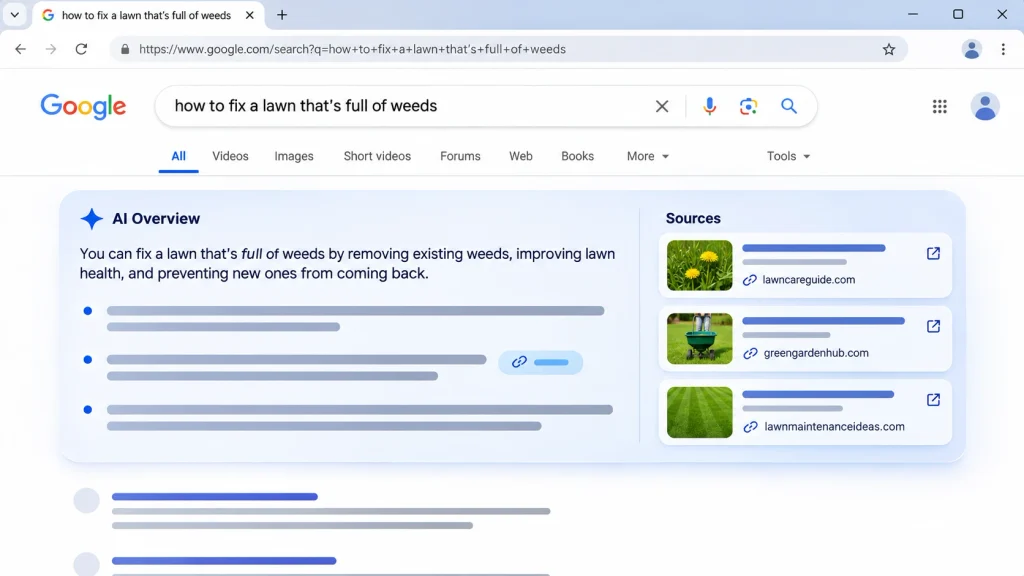
Understanding the mechanics changes what you do. Google’s AI optimization guide, last updated 10 July 2026, names two techniques. If any SEO term in this guide is new, a glossary of SEO terms covers the basics.
Retrieval-Augmented Generation (Grounding)
The model doesn’t answer from memory alone. It pulls relevant, up-to-date pages from Google’s search index using the core ranking systems, reads the specific information on them, and then writes a response with links to the supporting pages.
Takeaway: If Google’s ranking systems wouldn’t surface your page for a query, the AI system has nothing to pull from. Those systems lean on intent and entities, the core of advanced SEO.
Query Fan-Out
Before answering, the model runs several related searches at once.
Google’s example: for “how to fix a lawn that’s full of weeds,” the fan-out queries might include “best herbicides for lawns,” “remove weeds without chemicals,” and “how to prevent weeds in lawn.”
Each fan-out query has its own ranking. So a page can be cited for “lawn full of weeds” because it ranks well for “remove weeds without chemicals,” even if it sits on page three for the original query.
The mechanics are easier to picture once you see how query fan-out works.
Why This Explains the Top 10 Debate
Ahrefs’ March 2026 update looked at 863,000 keyword results and 4 million AI Overview URLs. It found that 37.9% of cited URLs appeared in the first 10 SERP results for the same query, a count that includes features such as featured snippets and People Also Ask. Another 31.2% ranked between 11 and 100, and 31.0% ranked beyond 100. Counting organic blue links only, the split is 37.1%, 26.2%, and 36.7%. In July 2025, the top-10 figure was about 76%.
Two caveats matter:
- Ahrefs says its parsing method improved between the two studies, so part of the drop is measurement.
- Other studies use different denominators. BrightEdge reported about 17% top-10 overlap, while studies that count “AI Overviews with at least one top-10 URL” produce much higher numbers.
The takeaway: Ranking still matters a lot, but it isn’t only about the head keyword anymore. Fan-out is the likeliest explanation, and it matches Google’s own description of how the system works. If you only track the head term, you will misread why you’re cited or ignored.
Passages, Not Whole Pages
Google says its systems can understand several topics on one page and show the relevant piece. Its May 2026 update also placed more links inline, next to the specific text they support.
Two independent position studies point the same way. CXL’s 100-citation sample found 55% of the cited passages sat within the first 30% of the source page. Kevin Indig analysed 18,012 verified ChatGPT citations and found 44.2% came from the first 30% of a document.
The CXL sample is small and doesn’t say how the 100 citations were collected, and Indig’s data is about ChatGPT rather than Google, so treat both as direction, not law.
AI Overviews and AI Mode Are Different Systems
Google says the two features may use different models and techniques, so their answers and links will vary.
Ahrefs’ September 2025 U.S. data puts numbers on it. AI Overviews and AI Mode cited the same URLs only 13.7% of the time, even though their answers were 86% semantically similar. Ahrefs also found 11% of AI Overviews had no citation at all, against 3% of AI Mode answers.
| AI Overviews | AI Mode | |
| Where it appears | On the normal results page, only when Google decides it adds value | A separate conversational experience the user chooses (or reaches via a follow-up from an AI Overview) |
| Answer length | Short summary | Long, multi-step answers with follow-ups |
| Citation overlap with the other surface | About 13.7% of URLs (Ahrefs, Sept 2025) | Same |
| Search Console reporting | Generative AI performance report (impressions) | Same report (impressions) |
| What to optimize | The clearest answer to the core question and its main sub-questions | Depth, comparisons, and follow-up coverage |
Work aimed at ChatGPT and other assistants is a separate job, which is where generative engine optimization comes in.
The Citation Ladder: Where You’re Actually Losing
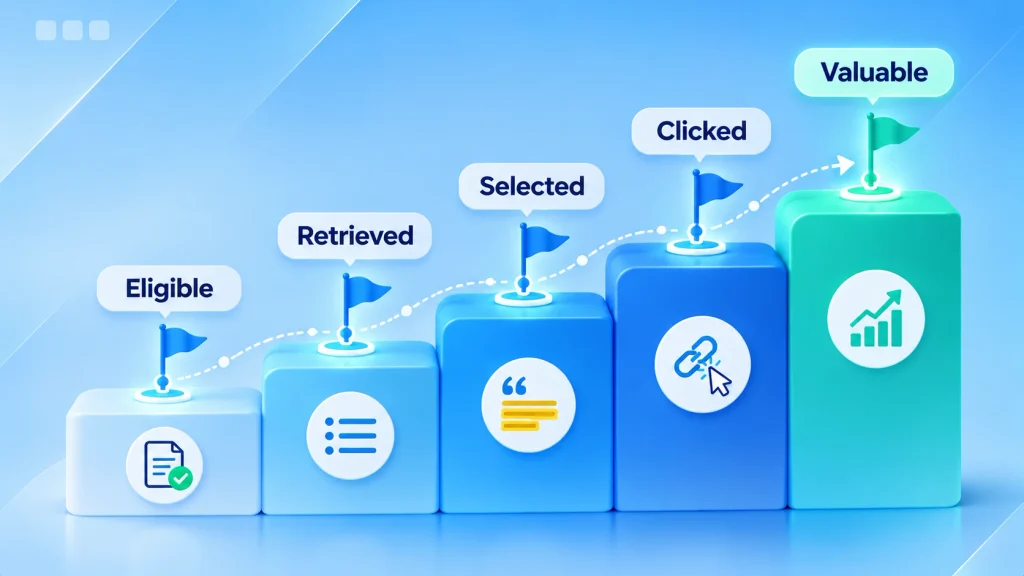
Most teams treat “not in AI Overviews” as a single problem. It’s really five separate ones. This ladder helps you find which one you have:
- Eligible: Can Google index the page, show a snippet, and use your site in AI features?
- Retrieved: Does the page rank for the query or any of its fan-out queries?
- Selected: Is the page’s passage the clearest, most useful, and best-supported answer for that part of the response?
- Clicked: Does the citation give people a reason to visit, such as data, tools, depth, or a perspective they can’t get from the summary?
- Valuable: Do those visits turn into leads, sales, or subscribers?
The nine steps below follow this ladder. Step 2 covers Eligible, Steps 1 and 3 cover Retrieved, Steps 4 to 8 cover Selected and Clicked, and Step 9 covers Valuable. Every rung rests on the basics of how SEO works.
How to Show Up in AI Overviews: A 9-Step Framework
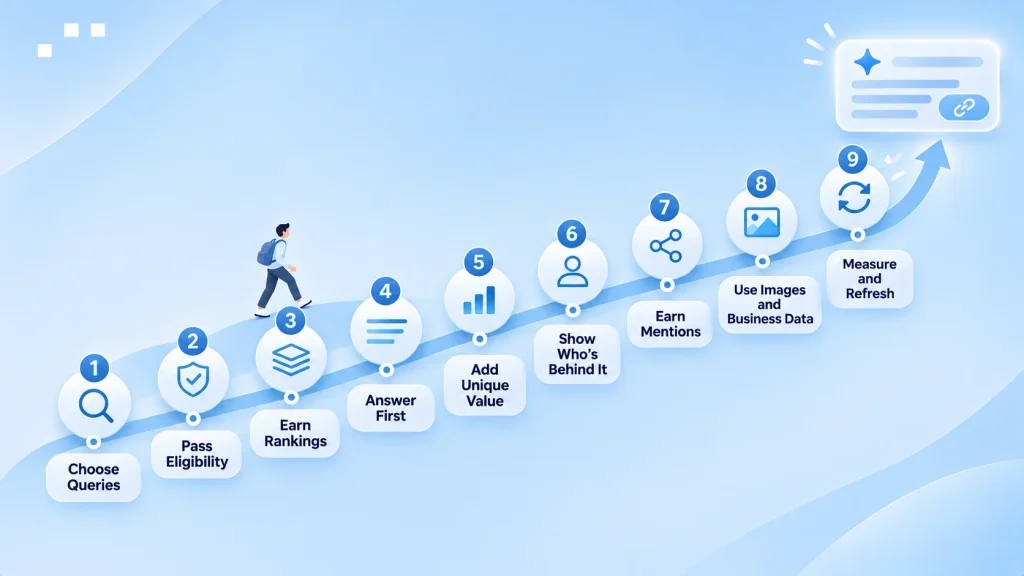
Step 1: Choose Queries Where You Can Realistically Be Cited
Don’t chase every keyword. Score them.
Where to find candidates:
- Search Console queries where you already rank in positions 1 to 20.
- People Also Ask questions for your core topics. These often sit close to the sub-questions an AI answer needs.
- Sales and support questions from your own team.
- Manual checks, or a tracker, for which of those queries trigger an AI Overview in your target country.
Plain keyword lists miss a lot here, which is why keyword research looks different in the age of LLMs.
AI Overview opportunity scoring matrix:
| Factor | Score 0 | Score 1 | Score 2 |
| AI Overview appears for the query | Never | Sometimes | Consistently |
| Your current ranking (query or close sub-query) | Not in top 50 | 11 to 50 | Top 10 |
| Your unique value on the topic | Same as everyone | Some original angle | First-hand data, tests, or expertise |
| Business value of the query | Low | Medium | High (leads or sales) |
| Click motive after the summary | None (simple fact) | Some | Strong (tools, comparisons, local or pricing detail) |
Start with queries that score 7 or more out of 10.
Be wary of simple facts. Even if you’re cited, few people will click through for an answer the summary already gives.
Example (hypothetical): Take the query “how much does a website redesign cost.” An AI Overview appears consistently (2). You rank 14th for it, so the ranking score is 1. You hold real project pricing that most pages lack (2). The query leads to enquiries (2). Readers will click for a full cost breakdown or a quote tool (2). The total is 9 out of 10, so it goes on the target list.
Step 2: Pass the Technical Eligibility Gates
Google’s requirements are short, but each one is a hard gate. A solid technical SEO checklist covers the wider site health around them.
- Indexed: Check the page in Search Console’s URL Inspection tool.
- Snippet-eligible: No nosnippet meta tag on the page. No max-snippet:0. No data-nosnippet on the section that holds your key answer.
- Crawlable: robots.txt allows Googlebot. Google’s AI features page also tells you to check that your CDN or hosting setup isn’t blocking crawling. Some security tools block bots by default, so check your firewall logs.
- Included in AI features: In Search Console, go to Settings → Search generative AI and confirm the site is set to include. The default is include, but someone on your team may have changed it.
- Content in text and rendered: Important content should exist as text, not only inside images. If you use JavaScript frameworks, confirm the rendered HTML contains your answer.
- Good page experience and less duplication: Google lists both as worthwhile. Duplicate URLs waste crawling.
Controls That Affect AI Overviews: What Each One Does
| Control | What it does to AI Overviews | Effect on normal rankings | Scope |
| Search Console “Search generative AI” control (Exclude) | Removes your links and content from AI Overviews, AI Mode, and generative AI in Discover, including as grounding | Google says it isn’t a ranking signal for the rest of Search | Whole property (child properties can inherit or override) |
| nosnippet | Blocks text snippets, which also blocks use in AI features | Removes snippets from normal results too | Page |
| data-nosnippet | Keeps a specific section out of snippets and AI features | Only that section is affected | Section of a page |
| max-snippet:[n] | Limits how much text Google can show | Limits normal snippets too | Page |
| noindex | Page can’t appear anywhere in Search | Page removed from Search | Page |
| robots.txt block on Googlebot | Google can’t crawl the page | Usually loses rankings | Path or site |
| Google-Extended | Limits use in some of Google’s other AI systems (training and grounding outside Search) | None | Site |
Two things often get confused here:
- Blocking Google-Extended does not remove you from AI Overviews. Google points to Googlebot rules and snippet controls for Search features.
- The opt-out is domain-level for now. Search Engine Journal reported that page-level controls aren’t available yet. The UK’s Competition and Markets Authority has given Google until March 2027 to provide them.
Should you opt out? For most businesses, no. Opting out doesn’t stop the AI Overview from appearing. It just hands the citation to a competitor.
The case for opting out is strongest for publishers whose content is the product, such as paywalled research. Even then, test the change on a separate Search Console property before applying it site-wide.
Step 3: Earn Rankings for the Query and Its Fan-Out Queries
This is where most AI Overview gains come from, and it’s plain SEO work.
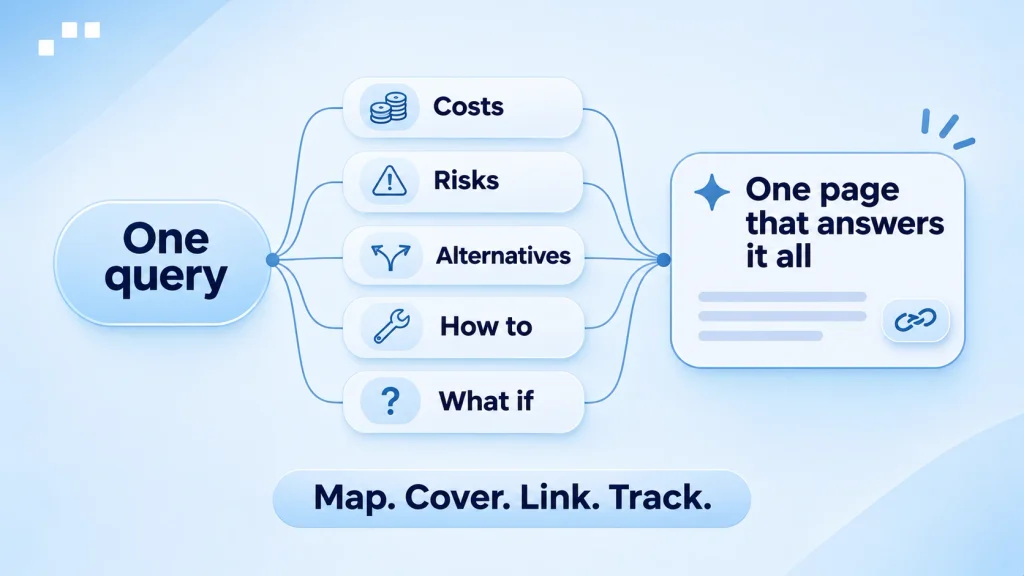
- Map the fan-out. For each target query, list the 5 to 10 sub-questions a full answer would need: comparisons, costs, risks, alternatives, “how to,” and “what if.” People Also Ask, related searches, and your own sales calls are the best inputs.
- Cover sub-questions on the page that owns the topic when they belong together. Build a separate page only when a sub-question has its own clear intent.
- Don’t mass-produce pages for every variation. Google’s guide warns that creating content for every fan-out query mainly to manipulate AI responses breaks its scaled content abuse spam policy, and calls it an ineffective long-term strategy.
- Link the cluster together. Google lists internal links as a way to make content findable. A clear pillar page with supporting pages helps both people and crawlers.
- Track rankings for the sub-queries, not only the head term. If you’re cited, find out which sub-query earned it.
Step 4: Put the Answer Where Google Can Link to It
Google says you don’t need to “chunk” content or rewrite it in a special AI style. You still need writing that is easy to quote accurately. Those are different things.
Write answer-first sections:
- Open each section with one or two sentences that answer its heading directly, then support the answer with detail.
- Use headings that match how people ask, such as “How much does X cost?” rather than “Pricing.”
- Make key sentences self-contained, so they still make sense when read alone next to an inline link. Name the subject instead of writing “it” or “this.”
- Put the core answer, definition, or finding in the first third of the page. The CXL and Indig position studies both point there.
- Use lists and tables for steps, options, and comparisons. That helps readers, and structured facts are easy to verify.
Before and after example (illustrative):
- Weak: “There are a lot of factors to consider, and it really depends on your situation, which we’ll explore below.”
- Stronger: “A Shopify store with under 500 products usually needs 4 to 6 weeks for a technical SEO cleanup, mostly spent on duplicate collection URLs and faceted navigation.”
The second version only works if the number is true for your business, so never copy a figure you can’t back up.
Don’t over-engineer the format. Google states there’s no ideal page length, so write the length the topic needs.
The same answer-first habit has helped pages win position zero and snippets for years.
Step 5: Add Value an AI Summary Can’t Copy
Google’s July 2026 guide says content people find unique and useful will “likely” influence your presence in generative AI search over time more than any other suggestion in the guide. It contrasts commodity content (its example: “7 Tips for First-Time Homebuyers”) with non-commodity content based on real experience. That focus on experience is why E-E-A-T and AI authority still matter here.
Non-commodity assets that earn citations and clicks:
- Original data, such as your own benchmarks, survey results, or anonymised client figures.
- First-hand tests with photos or screenshots.
- Pricing, timelines, and specifications from real projects.
- Expert opinions with a named person behind them.
- Local detail that only a local business knows. For a Bangladesh-based business, that might mean regulations, payment methods, or delivery realities.
- Clear verdicts (“we’d pick X for Y because Z”) instead of fence-sitting.
Why this matters for clicks too: If your page only repeats what the summary already says, there’s no reason to click. Original data and tools give readers a reason to visit.
Step 6: Show Who Is Behind the Content
Google’s AI features are built on its core ranking and quality systems, so the usual trust signals still apply.
- Named authors with real credentials, author pages, and an About page that explains who you are.
- Sources for claims, linked to the original study or documentation.
- Consistent entity information across your site, Google Business Profile, social profiles, and directories. Entity SEO and authority go deeper on this.
- Structured data that matches the visible page. Google lists this as a best practice, and Organization, Article, Product, and LocalBusiness markup can still earn rich results.
Schema’s Real Role (With the Evidence)
- Google: Structured data isn’t required for AI features, and there’s no special schema.org markup to add. Keep using it for rich results.
- Ahrefs (May 2026): Tracked 1,885 pages that added JSON-LD between August 2025 and March 2026, compared against 4,000 matched control pages. Over 30 days, AI Overview citations changed by −4.6% relative to controls. Ahrefs calls that drop statistically significant but says it can’t pin it on schema, because both groups were already declining. AI Mode (+2.4%) and ChatGPT (+2.2%) changes were statistically indistinguishable from zero.
- Scope: The study only covered pages that already had 100 or more AI Overview citations before schema was added. So “no lift” means no lift for heavily cited pages, and it says little about pages with few or no citations.
- Context: In a 6-million-URL first pass, AI-cited pages were almost three times more likely to carry JSON-LD. Ahrefs treats that as correlation, since better-run sites tend to have both schema and good content.
- FAQ rich results are gone. Google’s documentation changelog says the FAQ rich result stopped appearing in Search from 7 May 2026.
Bottom line: Use schema for accuracy and rich-result eligibility. Don’t expect it to win AI Overview citations by itself. For the implementation side, see this guide to schema markup for AEO.
Step 7: Build Real Off-Site Corroboration
AI Overviews draw on what the web says about you, not just what you say about yourself. That work sits closer to PR and digital marketing than to on-page SEO.
In Ahrefs’ 2025 study of 75,000 brands, branded web mentions were among the strongest correlates of AI Overview brand visibility (0.664), well ahead of backlinks (0.218). Brands in the top quartile for mentions averaged 169 AI Overview mentions, against 14 for the next quartile down. Ahrefs’ March 2026 post goes further and names YouTube mentions as the strongest correlating factor in that research.
This is correlation, not proof of cause. Well-known brands simply have more of everything. But it does show where visibility tends to come from.
What to do:
- Earn coverage in industry publications with data journalists can use.
- Publish on YouTube where video suits the topic. Among AI Overview citations that didn’t rank in the top 100, Ahrefs found 18.2% were YouTube URLs.
- Take part genuinely in forums and communities under a real name. Since Google’s May 2026 update, AI responses can show first-hand perspectives from discussions and social posts, with the creator’s name and community shown.
- Keep reviews and business listings current.
What not to do: Google’s guide says seeking inauthentic mentions isn’t as helpful as it might seem, because its spam systems feed the AI features too. Don’t buy mentions, plant fake forum posts, or run review schemes.
Step 8: Use Images, Video, and Google’s Business Data
- Images and video: Google says its generative AI features can bring in relevant images and video. If you already follow image and video SEO best practices, you’re already optimizing for this.
- Ecommerce: Keep Merchant Center feeds accurate. Google says product listings and details can appear in AI responses.
- Local businesses: Keep your Google Business Profile complete and up to date.
- Agent readiness (optional): Google’s guide suggests looking at agent-friendly website practices if AI agents booking or comparing on users’ behalf matters to your business. Treat this as early-stage. It isn’t a ranking factor today.
Step 9: Measure, Refresh, and Repeat
What Search Console Now Shows
On 3 June 2026, Google announced Search generative AI performance reports in Search Console. Google’s help page says the Generative AI performance report rolled out to all websites worldwide as of 31 August 2026.
What you get:
- Impressions only: how many times links to your site appeared in AI Overviews or AI Mode.
- Dimensions: Pages, Countries, Devices, and Dates.
- Search type filter: text-based web and multimodal searches (such as Lens).
What you don’t get:
- No clicks, CTR, or position.
- No queries.
- AI clicks are still counted in the overall Performance report, but they aren’t broken out.
Also note that Google’s data anomalies page records a logging error that reduced Generative AI impressions from 13 to 17 August 2026.
A Workaround for the Missing Query Data
- Export the Pages tab from the Generative AI report for the last 28 days.
- In the standard Performance → Search results report, filter by each of those pages and export its queries.
- Flag queries that are phrased as questions or that you know trigger AI Overviews.
- Compare the AI impressions trend for each page with that page’s clicks and CTR trend.
This gives you a likely set of queries that drive AI impressions. It’s an estimate, not a precise mapping, so present it to stakeholders that way.
Template columns for your tracker: Page · AI impressions (28 days) · Total impressions · Clicks · CTR · Top queries (from Performance) · AI Overview seen in manual check (Y/N) · Notes.
Third-Party Tools
Trackers such as Semrush, Ahrefs Brand Radar, SE Ranking, Otterly.ai, and Peec AI sample AI answers for your prompts and record citations. They help you see which queries cite you and who your competitors are. A comparison of AI SEO tools covers pricing and trade-offs.
Google cautions that no third-party tool has access to its internal ranking or AI systems, so treat their numbers as samples. Citations are also volatile. Ahrefs’ November 2025 study of more than 43,000 keywords found 45.5% of citations change when an AI Overview updates, and the AI Overview content itself changes 70% of the time.
If Bing matters to you, Bing Webmaster Tools launched an AI Performance report in public preview in February 2026 that focuses on citation frequency.
Measure Business Value, Not Just Citations
Google says clicks from results pages with AI Overviews are “higher quality,” meaning people spend more time on the site. That’s Google’s claim, so verify it in your own analytics.
Track engaged sessions, conversions, and assisted conversions from organic search in GA4. Compare pages that gain AI impressions with pages that don’t. The marketing KPIs that tie organic traffic to revenue make a good starting list.
Refresh on a Schedule
Seer Interactive’s “AI Brand Visibility and Content Recency” study (5,000+ dated URLs cited by ChatGPT, Perplexity, and AI Overviews) found about 85% of AI Overview citations pointed to content published in 2023 to 2025, and about 44% to content from 2025 alone. Recency clearly helps, but freshness has to be real.
- Update facts, figures, and examples.
- Show a visible “updated” date.
- Never change the date without changing the content.
Outdated pages cost more than most teams expect, since AI systems can keep reusing old answers, as LLM caching and visibility explain.
Do AI Overviews Hurt Traffic? What the Numbers Say About Zero-Click Searches
Yes, on average, for the queries where they appear. Being cited reduces the damage.
What Pew Found
Pew Research Center’s March 2025 browsing data showed people clicked a traditional result on 8% of visits when an AI summary appeared, against 15% without one. They clicked a link inside the summary on only about 1% of visits, and they were more likely to end their browsing session.
What Seer Found
Seer Interactive’s 2026 update covers 53 brands, 5.47 million queries, and 2.43 billion impressions. Organic CTR on AI Overview queries fell to 1.3% in December 2025, then recovered to 2.4% by February 2026.
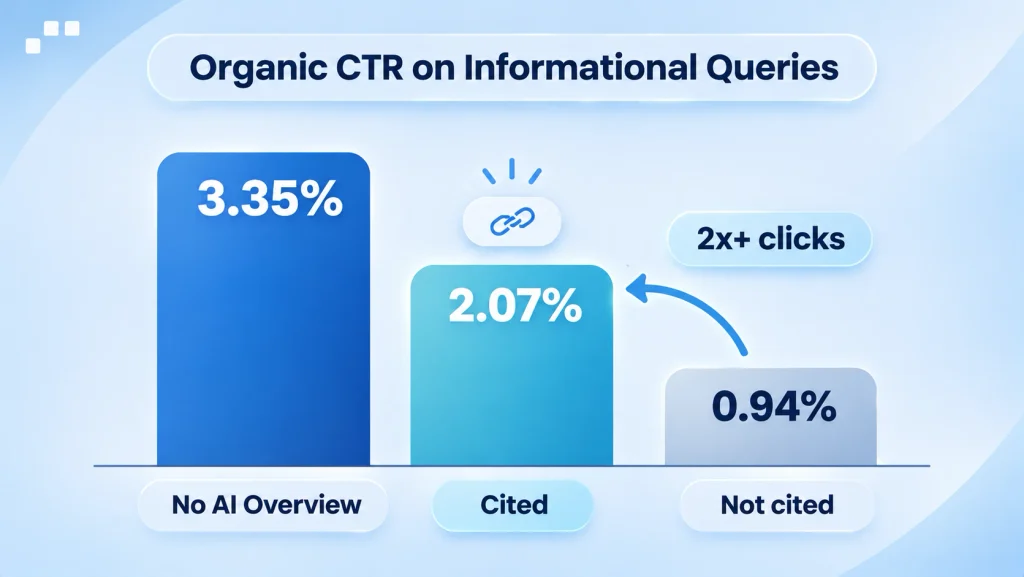
On informational queries across 2025, CTR averaged 3.35% with no AI Overview, 2.07% when the brand was cited in the AI Overview, and 0.94% when it wasn’t.
Put simply, a cited result earns more than double the organic clicks per impression of an uncited one, but still about 38% fewer than a result on a search with no AI Overview. Seer itself notes it can’t prove causation, since stronger brands may simply be cited more often.
Google has responded with design changes. In May 2026, it added inline links next to supporting text, hover previews on desktop, “Subscribed” labels, article suggestions at the end of answers, and first-hand perspectives from discussions. No independent study yet shows how much these changes have recovered clicks, so treat any claim that they have as unproven.
What to Do With This
Re-forecast organic traffic for informational queries. Shift reporting toward impressions, citations, conversions, and branded search. Put your effort into queries where people still have a reason to click.
There is also a case for treating zero-click visibility as an SEO advantage when it builds brand recall, even without the visit.
Myths vs Facts About AI Overviews Optimization
The llms.txt myth comes up most often. Before you spend time on one, check what an llms.txt file does and doesn’t do.
| Myth | Fact |
| “You need an llms.txt file.” | Google says Search ignores llms.txt and similar AI files. They neither help nor hurt in Google Search. |
| “Chunk content into tiny blocks for AI.” | Google says there’s no requirement to chunk content. Its systems can find the relevant part of a page. |
| “Rewrite everything in a special AI style.” | Google says you don’t need to write differently for AI. Its systems understand synonyms and meaning. |
| “FAQ schema gets you into AI Overviews.” | No special schema is needed. FAQ rich results stopped appearing on 7 May 2026, and Ahrefs’ controlled study found no citation lift for heavily cited pages that added schema. |
| “AEO and GEO are separate from SEO.” | For Google Search, Google calls optimizing for generative AI search “still SEO.” Other AI platforms may behave differently. |
| “Only top-3 pages get cited.” | Ahrefs’ March 2026 data had about 62% of cited URLs outside the first 10 SERP results for the same query (about 63% counting organic results only), though fan-out rankings likely explain much of that. |
| “Blocking Google-Extended removes you from AI Overviews.” | It doesn’t. Use snippet controls or the Search Console control. |
| “Opting out will hurt my rankings.” | Google says the Search generative AI control isn’t used as a ranking signal for the rest of Search. |
| “A tool can see Google’s AI ranking factors.” | Google says no third-party tool has access to its internal ranking or AI systems. |
| “Buying mentions will boost AI visibility.” | Google’s spam systems feed AI features, and inauthentic mentions are called out as unhelpful. |
Why Your Content Isn’t Showing in AI Overviews: A Diagnostic
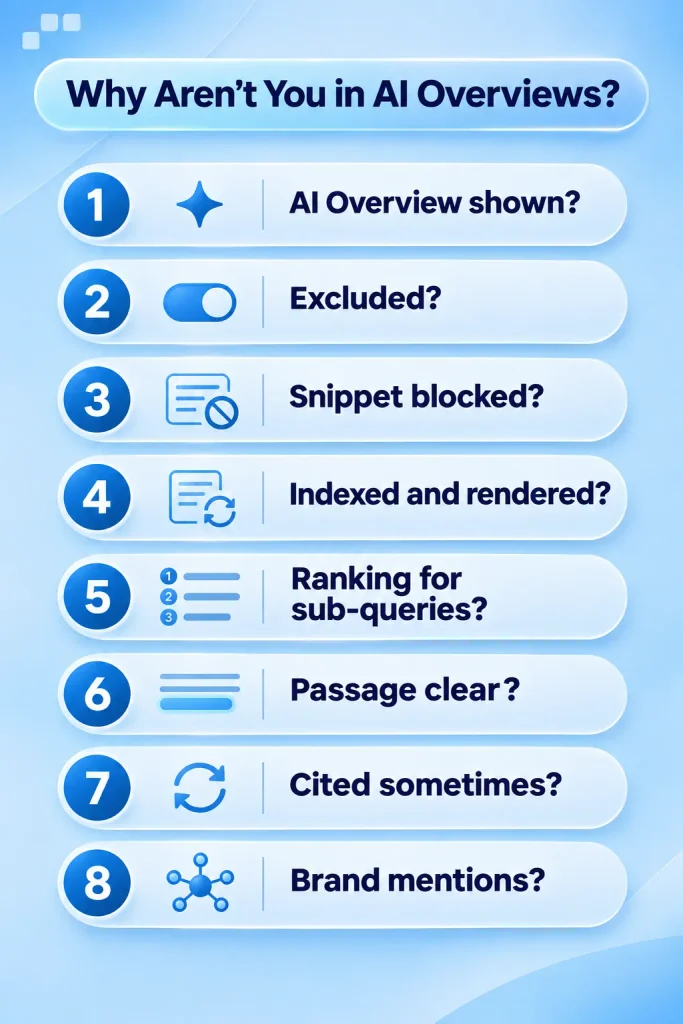
Work up the citation ladder in order:
- No AI Overview appears for the query? Then there’s nothing to win. Google only shows them when they add value. Pick a different target.
- Excluded? Check Settings → Search generative AI.
- Not snippet-eligible? Look for nosnippet, max-snippet, or data-nosnippet on key sections, using URL Inspection’s crawled HTML.
- Not indexed or not rendered? Check URL Inspection and test JavaScript rendering. Heavy frameworks also affect Core Web Vitals.
- Not ranking for the query or its sub-queries? That’s an SEO problem first. Go back to Step 3.
- Ranking but not selected? Your passage may be vague, buried, or the same as everyone else’s. Go back to Steps 4 and 5.
- Selected sometimes? Citations rotate. Track over weeks, not single checks.
- Low brand corroboration? Go back to Step 7.
Industry Notes: Where AI Overviews Hit Hardest
- Healthcare and education: Highest prevalence in BrightEdge’s data. Expertise, named reviewers, and original evidence carry the most weight, and health topics face Google’s strictest quality standards. Brands in health and wellness should treat accuracy as the first job.
- B2B technology: Prevalence is high, and queries are research-heavy, so comparison pages and original data are the easiest way to earn citations.
- Restaurants and local services: Local queries trigger AI Overviews far less often, but your Business Profile feeds Google’s AI answers. Keep it complete.
- Ecommerce: Shopping-style queries trigger AI Overviews less often. Informational “which X is best for Y” queries trigger them more. Keep Merchant Center feeds accurate.
- Publishers: The most exposed to click loss. The opt-out decision deserves a real test here.
AI Overviews Optimization Checklist
Eligibility
- Page indexed (URL Inspection)
- No nosnippet or restrictive max-snippet, and no data-nosnippet on the key answer
- Googlebot allowed in robots.txt, CDN, and firewall
- Site set to include in Settings → Search generative AI
- Key content in rendered HTML text
Targeting
- Query triggers an AI Overview in your target country
- Opportunity score of 7 or more out of 10
- Fan-out sub-questions mapped and covered without creating thin pages
Content
- Direct answer in the first one or two sentences of each section
- Question-style headings where natural
- Self-contained key sentences with named subjects
- At least one non-commodity asset (data, test, expert view, or local detail)
- Sources cited, author named, and updated date shown honestly
- Relevant images or video
Trust and Off-Site
- Author bio and About page
- Structured data matches the visible text
- Consistent business information across the web
- Earned mentions in relevant publications, video, and communities
Measurement
- Generative AI report reviewed monthly (Pages, Countries)
- Page-to-query join done for top AI pages
- Citation tracker set up for priority queries (optional)
- Conversions from organic tracked in GA4
- Refresh schedule set for top pages
Final Word
AI Overviews haven’t replaced SEO. They’ve raised the bar for it.
The sites that get cited are eligible, rank for the questions behind the question, say something specific and true, and get talked about elsewhere.
Start with the eligibility checks today. Score your query list this week. Then put your effort into the one thing no competitor can copy: your own experience and data.
If you’d rather have a team run this process with you, Notionhive’s generative engine optimization service covers AI search visibility from audit to tracking.
Frequently Asked Questions
How Do I Get My Website Into Google AI Overviews?
Make sure your pages are indexed, snippet-eligible, and included in Search Console’s Search generative AI setting. Then rank for the query or its related sub-queries with clear, original, well-sourced answers. Google says there are no extra requirements beyond normal SEO, and inclusion is never guaranteed. Teams that want hands-on help can start with answer engine optimization.
Do I Need to Rank in the Top 10 to Appear in AI Overviews?
No, but it helps. Ahrefs’ March 2026 study found 37.9% of cited URLs appeared in the first 10 SERP results for the same query (37.1% counting organic results only). Many of the rest likely rank for fan-out sub-queries instead.
Does Schema Markup Help With AI Overviews?
Not directly. Google says no special schema is needed, and Ahrefs’ May 2026 controlled study of 1,885 pages found adding schema produced no citation lift. Those pages already had 100 or more AI Overview citations, so the result says little about pages with few citations. Use schema for rich results and accuracy.
Does llms.txt Help With Google AI Overviews?
No. Google states that Search doesn’t use llms.txt or similar AI files. It may matter for other AI services, but it has no effect on Google Search.
How Long Does It Take to Appear in AI Overviews?
There’s no fixed timeline. A page first has to be crawled, indexed, and ranked, and Google says crawling alone can take days to months. AI Overview citations also rotate between answers, so check the Generative AI report monthly instead of expecting overnight results.
How Do I Track AI Overview Visibility?
Use Search Console’s Generative AI performance report for impressions by page, country, device, and date. Combine it with page-level query data from the standard Performance report, and add a third-party citation tracker if you need query-level samples.
What Is the Difference Between AI Overviews and AI Mode?
AI Overviews are short summaries on the normal results page. AI Mode is a conversational experience for deeper questions. They can use different models, and Ahrefs found they cite the same URLs only about 13.7% of the time.
Can I Opt Out of AI Overviews Without Hurting My Rankings?
Yes. The Search generative AI control in Search Console excludes your site from AI Overviews, AI Mode, and generative AI in Discover, and Google says it doesn’t affect your rankings elsewhere in Search. It currently applies at the site or property level, not per page.
Do AI Overviews Reduce Website Traffic?
On average, yes, for the queries where they appear. Pew found people clicked results on 8% of visits with an AI summary versus 15% without. Seer found cited brands still get notably more clicks than uncited ones.
Is GEO Different From SEO?
For Google Search, Google says optimizing for generative AI is still SEO. Other AI platforms, such as ChatGPT, work differently, and the gap is laid out in GEO vs traditional SEO.
Can a Small or New Website Appear in AI Overviews?
Yes. Google says AI features create opportunities for more types of sites, and citations increasingly come from beyond page one. Small sites and technology startups usually win on narrow, specific questions where they have real first-hand knowledge.

About Author
Tanzim Sarwar TazTanzim Sarwar Taz is a content writer with 7+ years of experience creating in-depth content on SEO, technology, web development trends, and AI-driven search. His work focuses on emerging topics such as AEO, GEO, search experience optimization, artificial intelligence, and modern web technologies, delivering practical insights backed by research and industry developments.