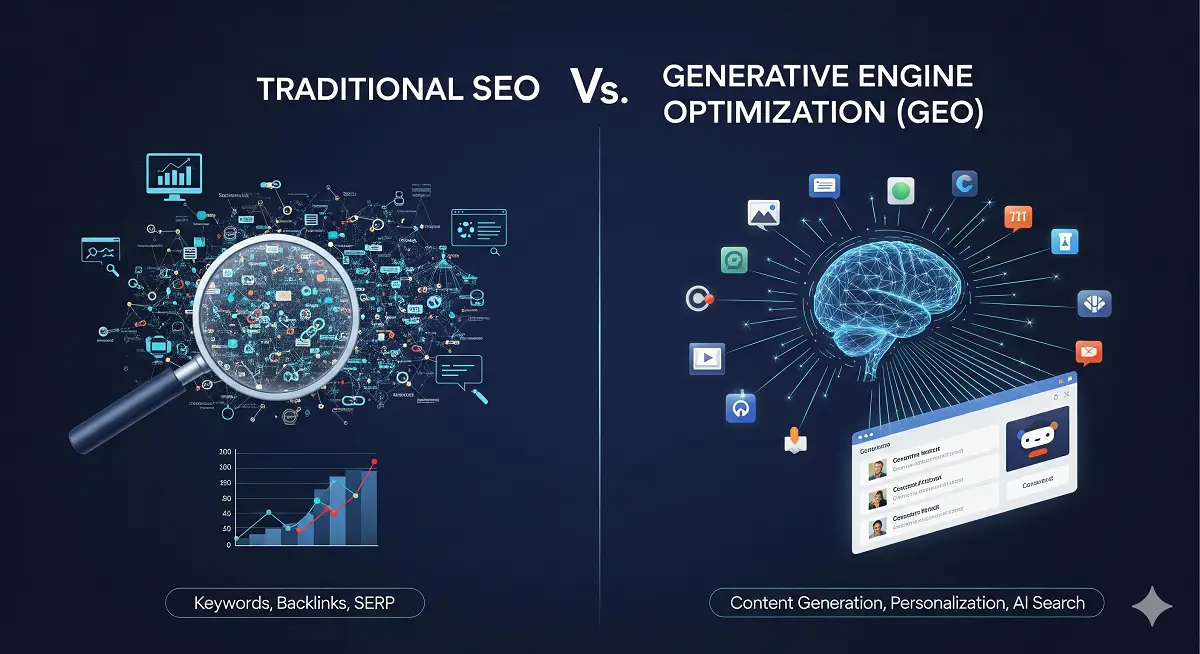
Search is no longer just about finding links. Today, you are more likely to receive a complete answer generated by AI than a list of websites to explore. This shift has changed how visibility works and how authority is earned online.
Generative Engine Optimization, or GEO, exists because search engines and AI systems now generate answers instead of simply ranking pages.
If you want your content to remain visible, trusted, and referenced, you need to understand how GEO works and why it matters for your business. That's what we will explain in this article.
Understanding Generative Engine Optimization
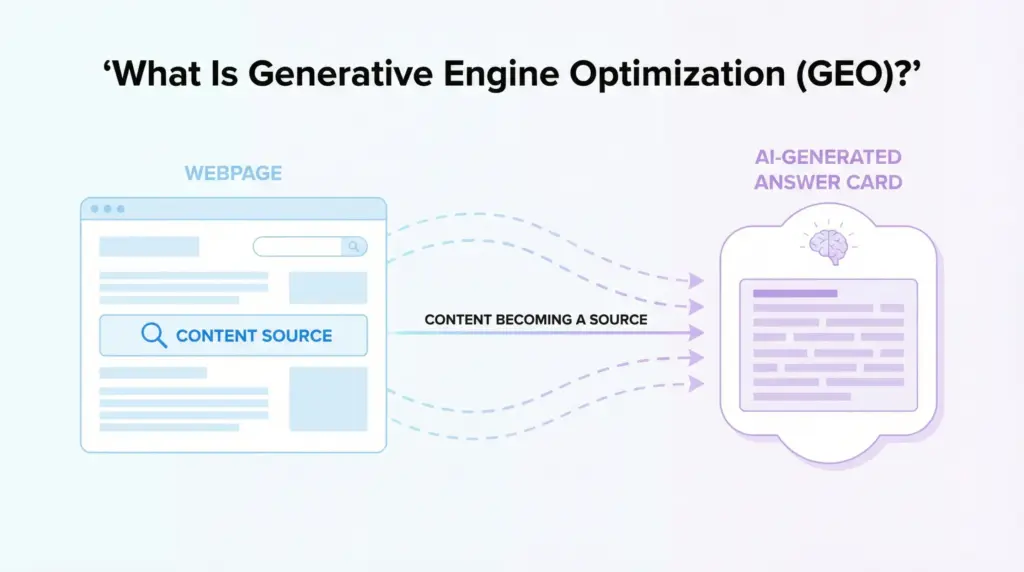
Generative Engine Optimization is the practice of optimizing content so it can be understood, trusted, and reused by generative AI systems when they create answers.
In simple terms, GEO helps your content become a source, not just a result.
When you ask an AI tool a question and receive a direct explanation, that response is generated using information pulled from multiple trusted sources. GEO focuses on making sure your content is one of those sources.
If traditional SEO helps your pages rank, GEO helps your ideas get repeated.
How Does GEO Work?
To understand GEO, you need to understand how generative engines behave.
Generative engines do not retrieve one page and show it to you. Instead, they:
- Analyze large volumes of content
- Identify trusted patterns and entities
- Generate a new answer using multiple sources
Your content is not shown verbatim. It is interpreted, summarized, and recomposed.
This is why clarity matters so much. If your content is vague, overly promotional, or inconsistent, AI systems struggle to reuse it accurately. When your explanations are clean and structured, generative engines can confidently reference them.
What GEO Looks Like in Practice
To understand GEO more clearly, it helps to picture a simple situation.
Imagine publishing a short article that explains what SEO is. The article opens with a clear definition and then walks through how SEO works in straightforward language. Common follow-up questions are answered naturally as the explanation progresses.
Later, someone asks an AI tool a basic question, such as:
“What is SEO and how does it work?”
The AI generates an answer. It does not copy the article, but the explanation closely mirrors the way SEO was described in that content.
This is GEO at work.
The content was clear and structured enough for the AI to understand and reuse when generating an answer. Even without a direct visit to the website, the explanation influenced how the question was answered.
Why Did GEO Become Important?
GEO did not appear as a trend. It emerged as a response to how people now search for information.
You no longer search the same way you did five years ago. You ask full questions. You expect immediate clarity. You want context, not ten tabs.
Search engines adapted to that behavior, and GEO is the result.
How AI Changed Search Behavior
AI tools and features have reshaped expectations.
Examples include:
- Google AI Overviews
- ChatGPT
- Perplexity AI
- Voice assistants
When you use these systems, you are not browsing. You are asking and receiving.
This means fewer clicks and more zero-click experiences. Visibility now happens inside generated answers, not only on websites.
If your content is not optimized for this environment, it becomes invisible even if it technically ranks.
Why Traditional SEO Alone Is No Longer Enough
Traditional SEO focuses on rankings, keywords, and links. Those still matter, but they no longer control the full discovery process.
Here is what has changed:
- AI answers often replace search clicks
- Users trust summarized responses
- Authority is assigned inside the answer itself
You can rank well and still lose visibility if AI systems do not reference your content.
GEO fills this gap by optimizing for reuse, not just ranking.
How GEO Is Different From Traditional SEO
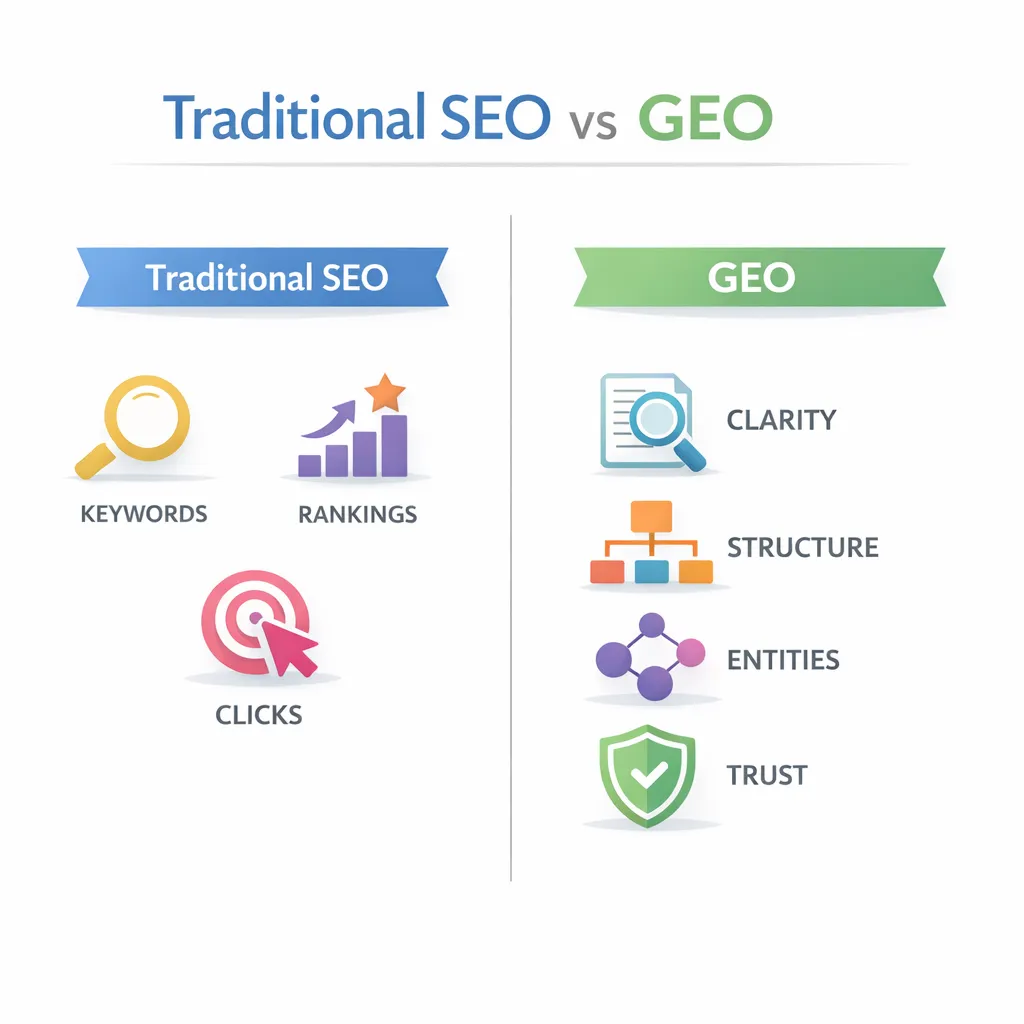
Understanding the difference between GEO and traditional SEO helps you adjust your strategy without confusion.
Traditional SEO asks
How do I rank higher for this keyword?
GEO asks
How do I explain this topic so clearly that an AI would reuse it?
The difference is subtle but powerful.
SEO vs GEO Key Differences
Traditional SEO focuses on:
- Keywords
- Rankings
- Pages
- Clicks
GEO focuses on:
- Clarity
- Structure
- Entities
- Trust
With GEO, your goal is not just to attract users. It is to become a reliable reference point. This means content quality becomes more important than content volume.
What Types of Content Perform Best in GEO?
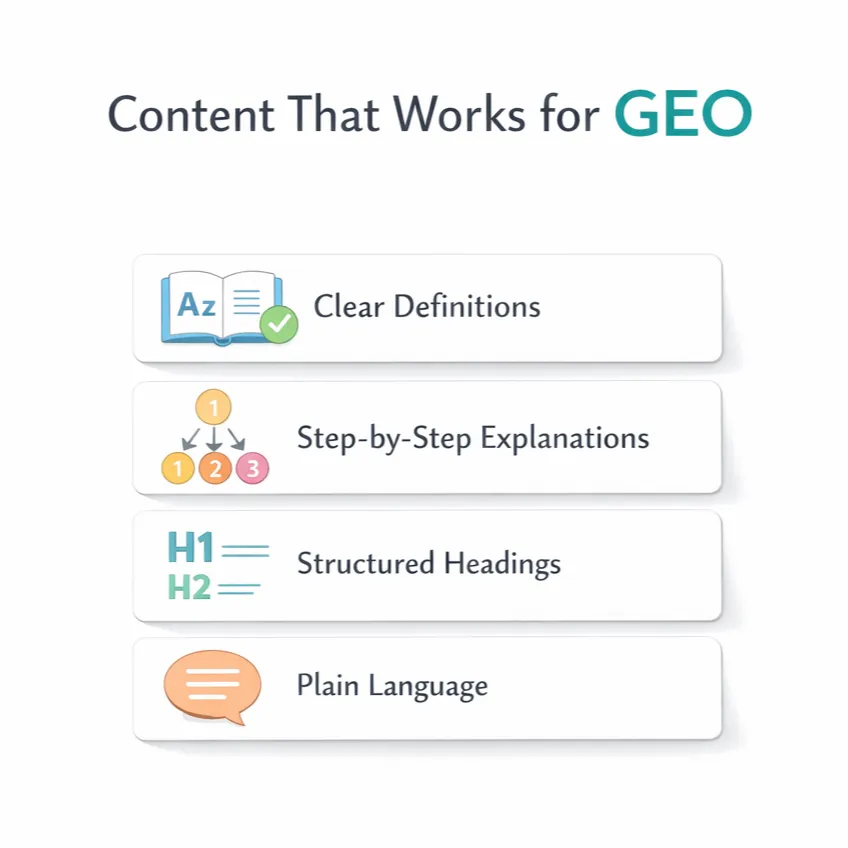
Not all content is equally useful to generative engines. GEO favours content that teaches, explains, and clarifies.
If your content reads like a sales page or a vague overview, it is harder for AI systems to reuse.
Why Explanatory Content Wins
Explanatory content works well because it reduces ambiguity.
This includes:
- Clear definitions
- Concept breakdowns
- Step-by-step explanations
- Plain language summaries
When you explain a concept as if someone is learning it for the first time, you make it easier for AI systems to reuse your explanation accurately.
Why Structured Content Matters
Structure is not optional in GEO. Clear headings, short paragraphs, and lists help machines identify key ideas quickly.
Well-structured content:
- Improves answer accuracy
- Reduces misinterpretation
- Increases reuse potential
Structure improves both human readability and machine comprehension at the same time.
How GEO Works With Other SEO Models
GEO does not replace existing SEO models. It works alongside them. Understanding this relationship helps you build a balanced strategy instead of chasing trends.
GEO and LLMSEO
LLMSEO focuses on how large language models interpret your content. GEO uses that interpretation to decide whether your content should be reused in generated answers.
If LLMSEO ensures understanding, GEO ensures visibility.
GEO and AEO
AEO focuses on providing direct answers in search results. GEO focuses on contributing to generated explanations across AI systems.
You can think of AEO as answering questions and GEO as shaping answers.
GEO and SXO
SXO focuses on user experience after discovery. While GEO helps your content appear in AI answers, SXO ensures that users who do click trust what they see.
Together, they support credibility from first exposure to engagement.
What Are the Core Principles of GEO?
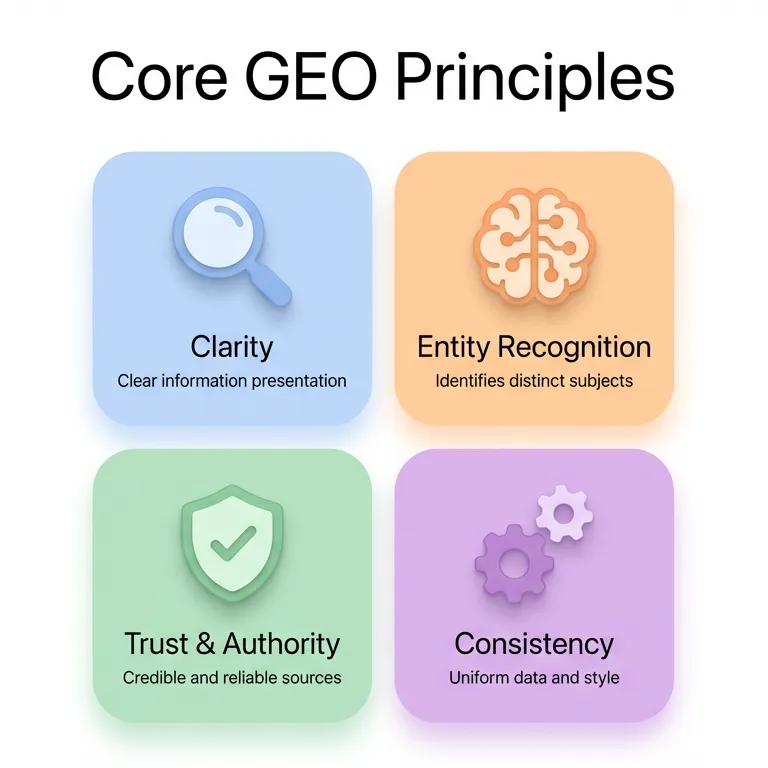
GEO is guided by a few simple principles. When you follow these consistently, your content becomes easier to reuse and trust.
Clarity and Simplicity
If your explanation is confusing, it will not be reused. Simple language and direct answers perform best.
Entity Recognition
Referencing real brands, tools, and concepts improves understanding. Entities help AI systems place your content in the right context.
Trust and Authority
Accurate information, consistent messaging, and credible sources matter. AI systems prioritize content they can trust. Understanding how AI evaluates authority is essential for GEO success.
Consistency Across Content
Contradictions reduce reuse. When your content aligns across pages, confidence increases.
How Do You Optimize Content for GEO?
Once you understand what GEO is and why it matters, the next question is how it can be applied in practice. GEO is not about rewriting everything that already exists. It is about changing how clarity, structure, and usefulness are approached.
Content that explains a topic completely and clearly aligns naturally with GEO principles.
Step-by-Step GEO Optimization Process
A simple process works best. Complex tools are not required to get started.
Step 1: Define the topic clearly
At the top of the content, explain what the topic is in plain language. A reader should understand the subject immediately without needing additional context.
Clear definitions help both machines and people establish understanding from the start.
Step 2: Answer the main question early
Generative engines prioritize direct answers. The most important explanation should appear near the top of the page before deeper detail is introduced.
This approach improves clarity and supports accurate summarization.
Step 3: Use structured headings
Content should be divided into logical sections using descriptive headings. Each section should focus on a single idea.
Strong structure makes it easier for AI systems to extract and reuse information correctly.
Step 4: Add supporting context
After the main answer, expand with explanations, examples, and related concepts. This adds depth without creating confusion.
Balanced expansion supports authority while maintaining readability.
How Do You Measure GEO Success?
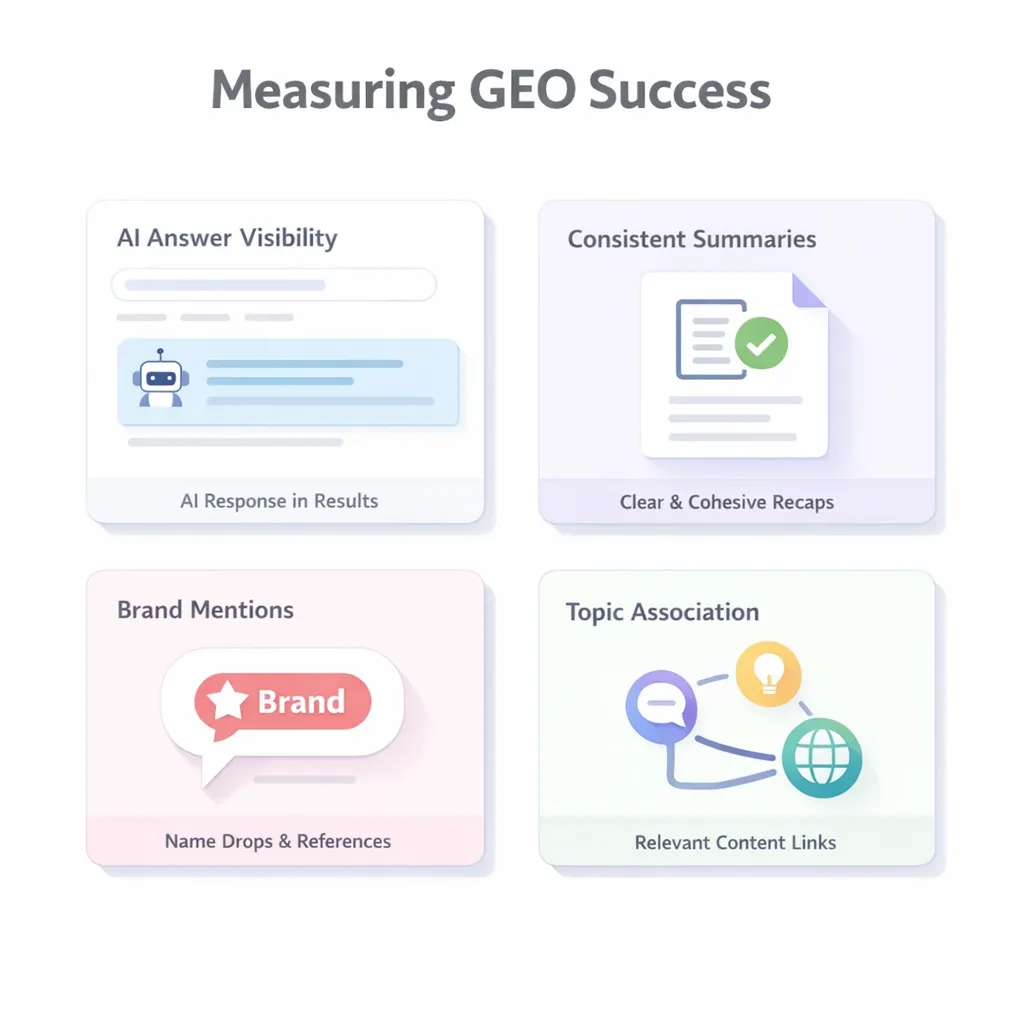
If you are used to measuring SEO through rankings and traffic alone, GEO can feel unfamiliar at first. That is because generative visibility often happens before you see obvious numbers move.
With GEO, success is less about immediate clicks and more about whether your content is being understood, trusted, and reused by AI systems.
Once you shift your expectations, measurement becomes much clearer.
Key Signals That Indicate GEO Progress
Early GEO progress usually shows up quietly. You may not notice traffic changes right away, but subtle signals start to appear.
Here are the indicators worth paying attention to:
- Your explanations appear in AI-generated answers
- AI tools summarize your content accurately
- Your brand or topic is referenced in platforms like Perplexity AI
- The language used in AI answers closely matches how you explain concepts
When you see AI systems describing a topic in a way that feels familiar, that is a strong sign your content is being reused correctly.
What GEO Success Looks Like Over Time
GEO does not deliver overnight wins. It builds credibility gradually.
In the early stage, you may notice that AI summaries are consistent and accurate, even if traffic stays flat.
In the mid stage, your content starts showing up repeatedly in generated answers, and your brand becomes more closely associated with specific topics.
In the long term, GEO pays off through stability. Visibility becomes more consistent, content holds up better during algorithm changes, and authority compounds across related topics.
If you are looking for fast spikes, GEO may feel slow. If you are building long-term trust, it fits naturally.
How Often Should You Review GEO Signals?
You do not need to track GEO every day. In fact, doing so can lead to over-analysis.
A practical approach looks like this:
- Check AI visibility and summaries once a month
- Review content clarity and structure quarterly.
- Test how AI tools explain your key topics from time to time.
This cadence gives you insight without turning GEO into a distraction.
What You Should Not Expect From GEO
Clear expectations prevent frustration.
GEO is not designed to:
- Replace traditional SEO
- Create instant traffic spikes.
- Show perfect attribution in analytics tools.
Its value shows up in influence and authority before it shows up in dashboards.
If you expect GEO to behave like paid traffic, you will miss its real benefits.
How GEO Works Alongside Traditional SEO Metrics
GEO does not compete with traditional SEO. It strengthens it.
Traditional SEO helps you measure visibility through rankings and clicks. GEO helps you understand whether your content is shaping answers and narratives.
When both improve together, your content becomes harder to replace and easier to trust.
Setting Realistic Expectations
The easiest way to think about GEO is as a quality standard rather than a campaign.
Each clear explanation you publish increases the chance that AI systems recognize your content as reliable. Over time, that recognition compounds.
If you focus on helping people understand topics clearly, GEO results tend to follow naturally.
Who Should Invest in GEO?
GEO benefits any organization that relies on visibility, credibility, or education as part of its growth strategy. If an audience asks questions before making decisions, GEO plays a meaningful role.
GEO for Content Publishers
Educational and informational publishers benefit from GEO by maintaining relevance even as click behavior changes. Clear explanations continue to influence understanding even when users do not visit the original source directly.
GEO for SaaS and B2B Brands
Complex products and services require explanation before conversion. GEO helps position brands as trusted sources when AI systems describe problems, categories, or solutions.
GEO for E-commerce and Service Businesses
Product-focused businesses also benefit from GEO. Purchase decisions often begin with research. Content that explains use cases, comparisons, and features clearly supports earlier decision stages.
Common GEO Mistakes to Avoid
GEO rewards clarity and credibility. Certain missteps reduce reuse potential even when content quality appears high.
Overwriting for AI
Writing exclusively for machines reduces trust. Generative engines still favor content that reads naturally and serves human understanding.
Ignoring Human Readability
Content that feels robotic discourages engagement. User behavior influences how AI systems assess usefulness and reliability.
Lack of Authority Signals
Clear explanations require supporting credibility. Missing author details, weak sourcing, or inconsistent messaging reduce trust and limit reuse. Authority often determines whether content is referenced or ignored.
The Future of GEO
GEO reflects a long-term shift in how information is delivered.
As AI-driven search continues to expand, demand for accurate, clear, and trustworthy explanations will increase.
How GEO Will Evolve With AI Search
Future search experiences will rely more heavily on generated responses.
Expected changes include:
- Reduced emphasis on links
- Increased use of summaries
- Higher expectations for accuracy and consistency
Content that teaches clearly remains valuable regardless of interface changes.
Why Early Adoption Matters
Early adoption builds recognition and trust before competition increases once AI systems identify content as reliable; that trust compounds over time and strengthens long-term visibility.
Conclusion
Generative Engine Optimization exists because search behavior has fundamentally changed. People now ask questions and expect clear answers rather than lists of links.
Optimizing for how answers are generated ensures content remains visible, trusted, and influential.
When clarity, structure, and authority guide content creation, GEO becomes a natural extension of effective communication rather than a separate tactic.
Whether you're building a website or developing SEO strategies, GEO principles help future-proof your visibility.
For businesses looking to stay competitive, Notionhive can help you implement GEO alongside traditional SEO and digital marketing strategies for a comprehensive approach to modern search. Contact us to get started today!
Frequently asked questions
1. What is GEO in simple terms?
GEO is the practice of optimizing content so AI systems can understand it, extract key points, and reuse it when generating answers. It focuses on clarity, structure, and credibility so your content can be accurately summarized.
2. Is GEO replacing traditional SEO?
No. GEO complements SEO. SEO helps pages rank in search results, while GEO improves how well your content performs in answer driven and AI generated experiences.
3. How is GEO different from AEO?
AEO focuses on earning direct answers in search features such as featured snippets. GEO focuses on helping AI systems generate fuller explanations using your content as a reliable source across multiple platforms.
4. What tools help with GEO?
Tools like ChatGPT and Perplexity can help you evaluate how content is summarized. Google Search Console helps you track visibility in traditional search. Structured content and auditing tools such as Screaming Frog can support GEO by improving crawlability and page structure.
5. How long does GEO take to show results?
GEO is typically a long term strategy. Some improvements can be seen quickly in engagement and clarity, but broader results often take months as authority and trust signals accumulate.
6. Does GEO work for small websites?
Yes. Smaller sites can perform well if they publish clear, accurate, and experience based content. However, in competitive topics, stronger brands may be referenced more often because they already have established trust.
7. Can GEO content still rank in Google?
Yes. In many cases, GEO aligned content improves rankings because it tends to be more structured, more helpful, and easier to understand. Strong GEO practices often overlap with strong SEO fundamentals.
8. Is GEO only relevant for AI tools like ChatGPT?
No. GEO applies to any search experience that relies on generated answers, including AI powered search features, assistants, and summarization systems. The core goal is making your content easier to interpret and reuse accurately.
9. What industries benefit most from GEO?
Industries that rely on explanation, comparison, and trust benefit most. This includes education, SaaS, ecommerce, and B2B services. In sensitive areas like healthcare and finance, GEO requires higher standards for accuracy, citations, and review.
10. How can GEO be implemented today?
Start by improving clarity, structure, and direct answers within existing content. Add clear definitions, strengthen topical coverage, show real experience, and support key claims with credible sources.

About Author
Tanzim Sarwar TazTanzim Sarwar Taz is a content writer with 7+ years of experience creating in-depth content on SEO, technology, web development trends, and AI-driven search. His work focuses on emerging topics such as AEO, GEO, search experience optimization, artificial intelligence, and modern web technologies, delivering practical insights backed by research and industry developments.