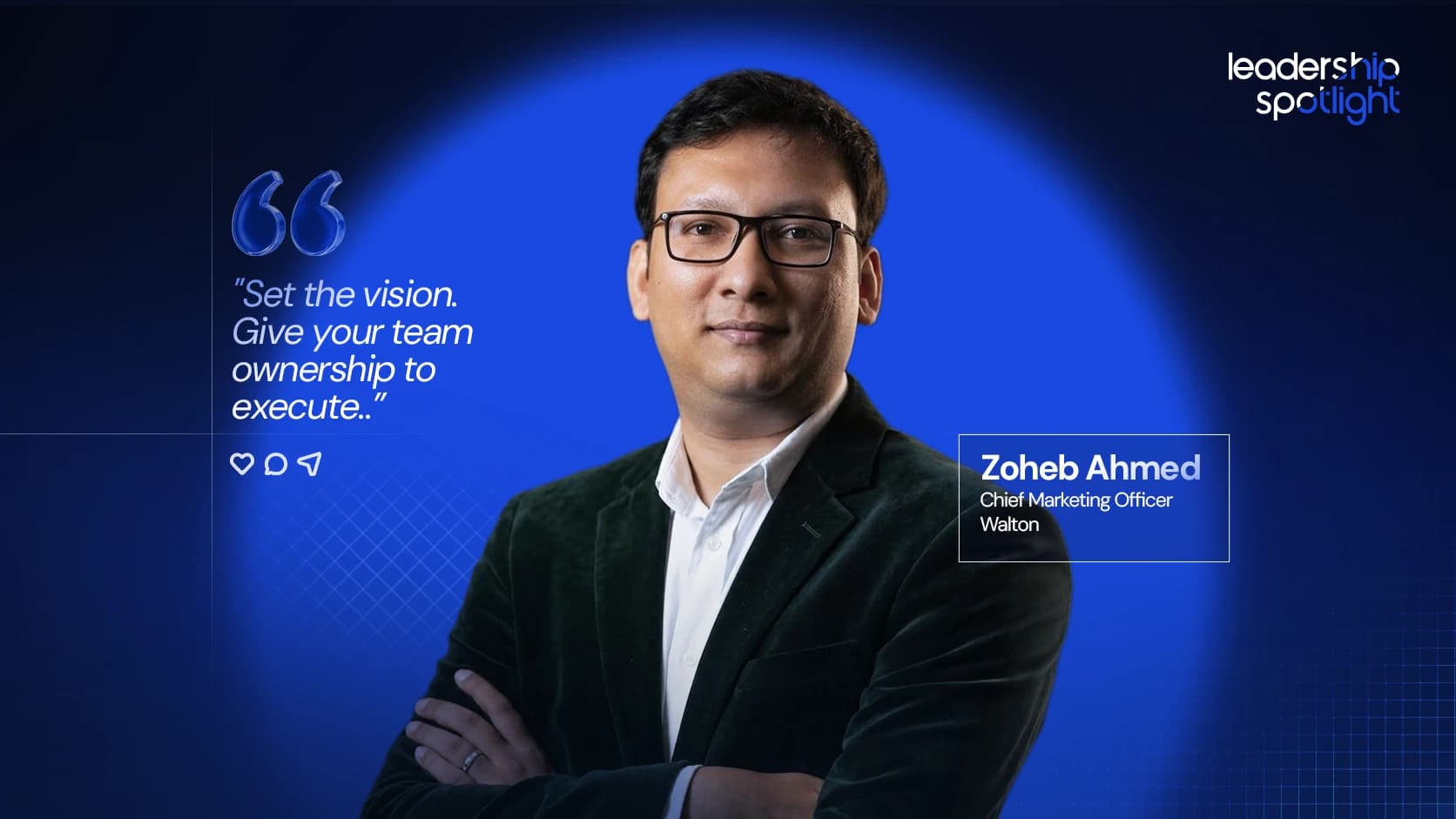
A conversation with Walton's Chief Marketing Officer about giving teams ownership, staying close to changing consumers, and why doing the right thing at the right time matters.
In Bangladesh's increasingly competitive consumer and technology market, leaders are expected to move fast. Strategies change. Consumer expectations shift. New competitors emerge, and teams are under constant pressure to execute faster.
But for Zoheb Ahmed, Chief Marketing Officer at Walton, speed without clarity and ownership creates another problem: people become executors instead of decision-makers.
His leadership philosophy centers on aligning brand vision with cross-functional execution, empowering teams to take ownership, and building brands that connect deeply with consumers in Bangladesh. The idea is straightforward: set the direction clearly, then give capable people the space to take it forward.
Clear Vision, Real Ownership
Strategy usually begins at the top. Execution doesn't.
For a large consumer brand, turning a strategic direction into market results requires different functions to move together. Marketing may shape the brand, sales understands what's happening on the ground, retail teams interact directly with customers, and product and distribution teams determine whether the promise can actually be delivered. A good strategy can easily lose momentum when those functions operate separately.
Ahmed's view of leadership connects the two sides: clarity at the leadership level and ownership across the organization. That means people should understand not only what they're expected to execute, but why it matters. When that context is clear, teams can make better decisions without waiting for instructions at every step.
If every decision has to travel upward, leadership becomes a bottleneck. If the vision is clear and ownership is distributed, the organization can move.
Hire for Ownership and Adaptability
Asked what he values most when hiring, Ahmed points to two qualities: strategic adaptability and a strong ownership mindset. He looks for people who understand data-driven brand building and category development, but who also take the initiative to turn that understanding into execution.
There's an important difference between knowing what should happen and feeling responsible for making it happen. An employee with an ownership mindset doesn't stop at "the campaign isn't performing." They start asking why it isn't performing, what changed, what the data suggests, and what to test next. That mindset shrinks the distance between identifying a problem and solving it.
Adaptability matters here because in marketing, yesterday's answer can become today's wrong assumption. Real adaptability isn't about reacting quickly. It's recognizing when new information requires a different decision, while still holding onto the underlying business objective. Changing direction every time a new trend appears isn't adaptability. It's a distraction.
Micromanagement Slows More Than Execution
Asked what managers should stop doing if they want stronger teams, Ahmed was direct: "Managers must stop relying on top-down micromanagement, which suffocates creativity and slows down execution."
Micromanagement usually comes from a desire to protect quality and reduce mistakes, so the manager stays involved in every decision. But when that becomes the normal way of working, the team stops deciding and starts checking, asking, "what will my manager approve?" instead of "what's the right decision?" Even capable employees can become dependent on instructions.
Ahmed argues for the opposite: "Leaders should provide a clear strategic vision and grant their teams the ownership to make decisions." The direction still matters. The standards and accountability still matter. But the team gets enough room to think, decide, and take responsibility for the result.
Ownership Is How Executors Become Leaders
Someone can become an excellent executor by following instructions accurately. But leadership requires more: judgment, decision-making, accountability, the ability to act when the answer isn't obvious. Those capabilities only develop when people are given meaningful responsibility.
That asks something uncomfortable of managers: if you want people to develop judgment, you have to let them use it, even when they reach a different conclusion than you would, and even when they make a mistake. Without that space, an organization can produce excellent followers while struggling to produce its next generation of leaders.
Stay Close to the Consumer
Marketing leadership becomes difficult when leaders get too far from the market. Ahmed makes it a habit to stay connected to changing consumer behavior: studying data, following high-impact campaigns in Bangladesh and abroad, and learning from business challenges across retail, FMCG, electronics, and automotive.
That cross-industry view matters because customer expectations don't develop inside individual industry boundaries. A consumer who gets seamless service from a retailer may start expecting the same convenience from an electronics brand. Good marketers don't only watch their direct competitors. They watch consumers.
Data Tells You What. Frontline Teams Tell You Why.
It's easy for senior leaders to become dependent on dashboards, research, and presentations. All of that matters, but the people interacting with customers every day often notice things before they show up in a monthly report. Sales teams hear objections repeatedly, and retail teams see what customers compare before buying.
Data might show a product underperforming. Someone on the frontline can often explain why in one conversation. The higher someone moves in an organization, the easier it becomes to lose touch with what's happening at the customer level. Strong leaders deliberately close that gap.
The Lesson: Do the Right Thing at the Right Time
Asked about a decision he regrets, Ahmed went back to his university years. He began working professionally while still studying, wanting production and practical experience early, and he got it. But the heavy workload affected his academic focus and resulted in a lower CGPA, which later made certain paths, including roles at multinational corporations and leadership tracks in banking, harder to enter.
Ambitious young professionals are constantly told to start early, network early, and build experience faster. Ahmed's experience adds a qualification to that advice: moving early isn't always the same as moving wisely. Different stages of life have different priorities, and neglecting the one you're in to get a head start elsewhere can narrow the options you'll want later.
The other side of the story matters too. A lower CGPA made some opportunities harder, but it didn't determine the rest of his career. As he puts it, by the grace of Allah, he went on to build his career across some of Bangladesh's prominent manufacturing and consumer companies, including Apex, Meghna Group, Bengal Group, Runner, and Walton.
A past decision can have consequences without becoming a permanent definition of someone's potential, which is also why Ahmed's advice to younger people isn't to count on recovering later from something that can be handled properly today. Learn from other people's mistakes where you can. You don't need to make everything yourself.
What's Next: A More Competitive Market
Looking five years ahead, Ahmed expects a significant change in Bangladesh's electronics and hi-tech industries. More local competitors will enter, competition will intensify, and consumers are likely to benefit as prices come under pressure and advanced technology becomes more accessible.
But what benefits customers will make the environment harder for brands. The competitive question is shifting from "who has the better product?" to "who delivers the better overall experience?"
When Products Look Similar, Everything Around Them Matters
Ahmed expects product parity to increase as competing brands converge on similar technologies, features, and specifications. That shifts where competition actually happens: customer service, product availability, the retail experience, and after-sales support.
Picture two products with similar specs and pricing: one easy to find with a smooth buying process and dependable support, the other hard to find with an inconsistent, frustrating experience. The technical gap may be small. The customer's experience of the two brands won't be.
Adaptability Will Decide Who Keeps Up
Ahmed believes continuous adaptability will become essential as competition increases and preferences evolve faster, not by chasing every new development, but by recognizing meaningful change and responding before old assumptions become liabilities. The organizations that succeed won't always predict change perfectly; they'll notice it earlier, learn faster, and adjust more effectively.
A highly centralized organization struggles to adapt because every response needs approval from the top. An empowered one can respond closer to where the change is happening, another reason ownership isn't just a people-development philosophy. It's a competitive advantage.
Advice for the Next Generation
Two themes stood out when Ahmed talked about what the next generation of leaders needs to hear: the discipline to never cut corners, and the humility to actually listen when they're told they're wrong.
No Shortcuts
Asked what he'd tell the next generation of business leaders, Ahmed returned to the lesson shaped by his own journey: "There is no room for shortcuts." His advice is to respect timing, give each milestone the effort it deserves, and push beyond the minimum. Whatever a task requires, try to give an additional 10%.
The exact number matters less than the principle: don't develop a habit of doing just enough. Care about the quality of the work and the standard you attach your name to. That discipline doesn't always create an immediate reward, but over a career, it becomes a reputation.
Learn to Take Criticism
Ahmed's final point: "If you cannot take proper advice and genuine criticism on board, your leadership window will simply never open." Leadership increases responsibility. It doesn't eliminate the possibility of being wrong, and seniority can actually make honest feedback harder to receive, since people grow more cautious about challenging someone with authority.
Someone who gets defensive every time they receive feedback eventually teaches people to stop giving it, and loses access to information they need. Accepting criticism doesn't mean agreeing with everyone. It means staying secure enough to listen, evaluate it honestly, and change when it's valid.
Leadership That Gives People Room to Grow
The clearest theme across the conversation is the relationship between clarity and ownership. Leaders need to know where they want the organization to go, but they can't personally carry every decision required to get there. They need people who adapt, take ownership, and have enough confidence to act on a clear objective.
That means replacing micromanagement with direction, staying close to customers rather than relying only on assumptions, learning continuously as the market changes, and having enough humility to accept criticism.
Ahmed's own career adds one more lesson: progress isn't only about moving fast. Sometimes leadership begins with understanding what deserves your attention right now: doing the right thing, at the right time, without shortcuts.
Key Takeaways
- Connect vision with execution: strategy creates value when cross-functional teams understand the direction and can act on it.
- Hire for ownership and adaptability: look for people who take responsibility and adjust as the market changes.
- Stop micromanaging: clear direction plus decision-making freedom builds stronger teams than top-down control.
- Use responsibility to develop leaders: people build judgment by making real decisions, not by following instructions forever.
- Stay close to consumers: data, market trends, and frontline feedback each reveal a different part of the picture.
- Respect timing, and don't let a setback define you: moving faster isn't always moving forward, and one path narrowing doesn't close every path.
- Prepare for product parity by adapting continuously: as products converge, service and experience become the real differentiators.
- Avoid shortcuts: consistently putting in the extra effort builds standards, reputation, and long-term credibility.
- Accept constructive criticism: leaders who stop listening eventually stop learning.
About Leadership Spotlight
Leadership Spotlight is Notionhive's interview series featuring business leaders from across Bangladesh's industries. The practical wisdom, honest lessons, and real experiences that shape how successful leaders build teams and drive growth.

About Author
Notionhive TeamThe Notionhive Team is a multidisciplinary group of strategists, SEO specialists, and marketing experts, all committed to helping businesses grow through smart digital marketing and meaningful innovation. They share practical insights, emerging trends, and expert perspectives to help organizations make informed decisions and thrive in an ever-evolving digital landscape.