Imagine this: A potential customer needs exactly what you sell. They open ChatGPT, ask a question, and get a perfect, detailed recommendation in seconds. Your competitor's name is right there, but yours isn't.
And the worst part? You have no idea it even happened because it never showed up on your analytics dashboard!
This isn't a future scenario. It's the present reality for most brands. The way we find information has shifted under our feet.
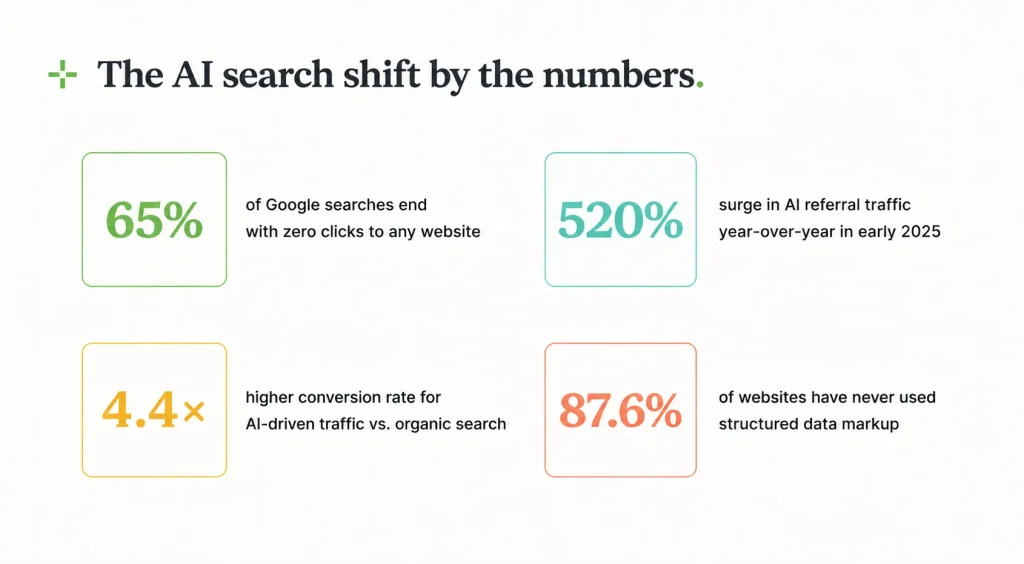
Nearly 65% of Google searches now end without a single click, and AI-driven referral traffic exploded by over 500% in just one year! People aren't browsing lists of links anymore; they’re getting direct answers from AI before they ever see a website.
AEO (Answer Engine Optimization) and GEO (Generative Engine Optimization) are the tools built for this new world. They aren't replacing your SEO; they’re the next level on top of it.
How We Got Here
The rise of AEO and GEO did not happen overnight. It started with Google’s "featured snippets," which trained us to expect answers without having to click.
Then, voice search made us talk to our devices in full sentences.
When ChatGPT arrived in late 2022, the floodgates opened. Suddenly, you could have a real conversation with a machine and get a synthesized answer instead of a "to-do list" of websites to visit.
Today, tools like Perplexity, Gemini, and Claude have made this the new standard: Ask, get an answer, move on. No scrolling required.
What AEO and GEO Actually Are
While people often use these terms interchangeably, they actually solve different problems. Getting clear on the difference is where better content decisions start.
Answer Engine Optimization (AEO)
AEO is the practice of structuring your content so that AI systems can easily "grab" it and repeat it as a definitive answer to a user.
Think about what happens when you type a question into ChatGPT or trigger an AI Overview on Google.
The system does not send you to a list of websites. It reads through available content, finds the most clearly structured and relevant answer, and surfaces it directly.
AEO is the strategic effort you put in to ensure that when an AI goes looking for an answer, it chooses your words over everyone else's.
The focus shifts away from keyword density and page rankings. Instead, you are thinking about how directly you answer the question, how cleanly your content is structured, and whether an AI can extract your response without ambiguity.
Key actions that produce measurable AEO results:
- Lead with the punchline: Provide a direct answer within the first 40 to 60 words of a section.
- Modular writing: Create self-contained blocks of text that provide full value even if read in total isolation.
- FAQ styling: Use clear question-and-answer formats that mirror how people actually speak to AI.
- Increase fact density: Use hard data and specific details, as "information richness" signals high credibility to AI retrieval models.
- Technical signposting: Use structured data, such as the FAQPage schema, to give AI a "map" of exactly what your content covers.
Here is a statistic that deserves your attention: simply using the FAQPage schema makes your content 3.2 times more likely to be featured in an AI Overview. Yet, a staggering 87.6% of websites haven't used structured data at all. That massive gap represents your biggest competitive advantage, not just a technical detail
Generative Engine Optimization (GEO)
GEO operates at a different layer. Where AEO is about being the answer to a specific question, GEO is about making sure your brand shows up in the broader conversation when AI platforms synthesize multi-source responses.
When someone asks an LLM to compare tools, recommend an agency, or explain the best approach to a problem, the AI does not pull from a single source. It synthesizes across several sources. GEO is the work you do to ensure your brand stays consistently in that mix.
A peer-reviewed paper from Princeton, Georgia Tech, and IIT Delhi presented at KDD 2024 found that targeted GEO strategies can boost your AI visibility by 30 to 40%
It also found that traditional keyword-based tactics perform poorly in generative search contexts. Worth paying attention to.
To truly gain ground in GEO, you need to focus on these high-impact signals:
- Proprietary Data: Publish original research that forces others to cite you, building a "citation network" that AI models track.
- Author Authority: Use named, credentialed experts, as AI systems increasingly verify the identity and reputation of content creators.
- Digital PR: Secure mentions and citations from other authoritative voices in your industry to validate your brand's relevance.
- Multi-Platform Presence: Be active where AI models go to "learn," specifically high-signal platforms like YouTube.
- Domain Strength: Maintain high traffic and authority, as top-tier domains receive three times more AI citations than lower-traffic sites.
You might be surprised to see YouTube as a core GEO pillar. Between August and December 2025, YouTube’s share of AI citations nearly doubled!
Interestingly, 40% of those cited videos had fewer than 1,000 views. This proves that for AI, massive popularity doesn't matter nearly as much as the clarity and depth of the information provided.
How They Work Together
AEO and GEO are not competing strategies. They work at different layers of the same goal, and you need both.
Think of a concrete example: someone is evaluating project management tools. AEO gets your content selected when they ask, "What is the best project management tool for remote teams?" Your structured, direct answer gets surfaced.
GEO ensures that when they follow up with "Can you compare the top three options?" your brand stays in the conversation, drawing on the broader ecosystem of citations, mentions, and authority signals you've built.
One gets you found in the moment. The other keeps you relevant across the entire research journey.
Together, they create a compounding effect. The more your content gets cited and extracted, the more authoritative your brand becomes to AI systems over time.
Think of it this way: AEO provides the answer, GEO influences the final decision, and SEO earns the click.
The brands winning at AI search right now are not treating these as separate projects. They are building content that does all three simultaneously.
How Big is This Shift, Really?
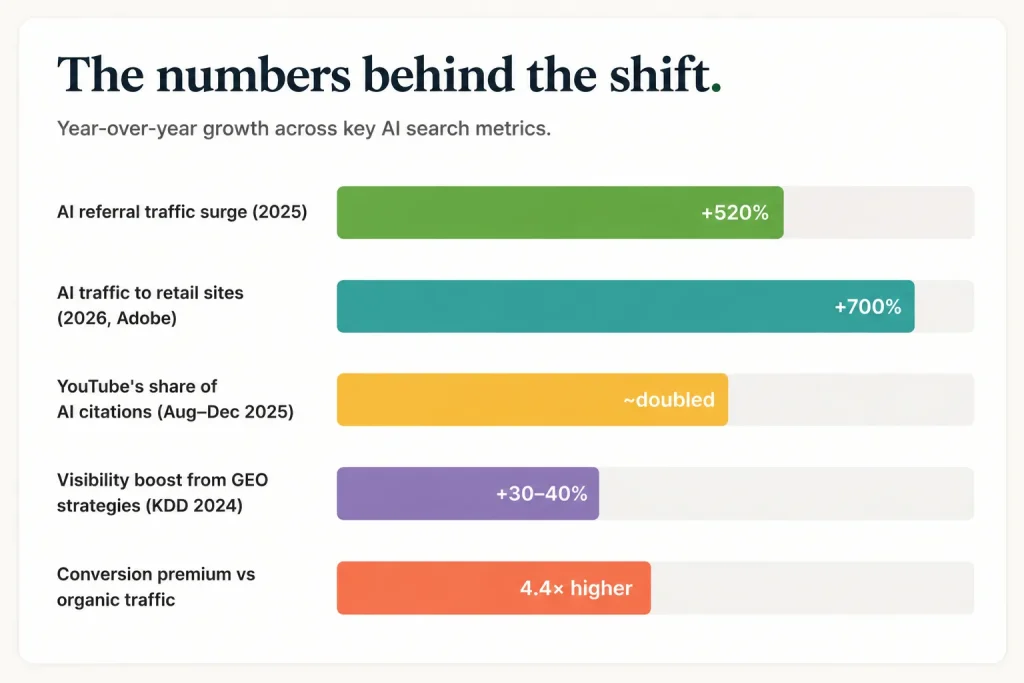
Here is where things get interesting. The numbers behind AI search growth are not gradual. They are quite steep and accelerating rapidly
Here are some facts for you:
- Mainstream Adoption: At least 50% of consumers are now using AI-powered search tools for daily information gathering.
- The Rise of the Bots: More than half of all web traffic is now driven by automated bots rather than human fingers clicking on screens.
- The "Zero-Click" Reality: Roughly 60% of Google searches now end without a single click to a third-party website. When AI Overviews are present, that number can reach 83%.
- The Traffic Explosion: AI referral traffic surged by over 520% year-over-year in early 2025. By early 2026, Adobe reported that AI-driven traffic to retail sites had skyrocketed by nearly 700%.
But here is the statistic that should truly change how you view your marketing budget: Traffic originating from AI search converts at 4.4 times the rate of traditional organic traffic.
These visitors arrive already informed, already trusting a recommendation. The AI has essentially pre-sold them before they ever reach your site.
The opportunity is massive, but it comes with a strict prerequisite: you have to be the brand the AI chooses to showcase.
How AEO and GEO Compare to Traditional SEO
You might be wondering whether this is just SEO with different terminology. It is not. They share some DNA, but they are genuinely different disciplines with distinct goals, signals, and outcomes.
Let's break it down for you:
| Dimension | SEO | AEO/GEO |
| User experience | Search, see links, click through | Search, get an answer, stay on the platform |
| Output format | Stack-ranked list of links | Synthesized text with occasional citations |
| What you are optimizing for | Rankings and clicks | Mentions, citations, and recommendations |
| How content gets found | Crawling and indexing | Training data, retrieval, and real-time search |
| Consistency of results | Relatively stable | Varies by model, location, memory, and prompt |
| Maturity of the field | Established, with clear playbooks | Nascent, still being figured out |
The user flow tells the story clearly. With traditional search, you type a query, scan results, click a link, browse a website, go back, and try another.
With AI search, you ask a question, get an answer, and ask a follow-up. Your website visit may never happen at all.
That changes what visibility means. It changes what performance looks like. And it changes what your website is actually for.
But Here is the Good News!
If you are doing SEO well, you already have a head start. When someone asks an LLM a question, one of its primary sources of information is content from the top SERP results. The model pulls from those pages and synthesizes the best answer it can based on the user's intent.
So SEO is still the foundation. It is not going anywhere.
However, it is important to understand that SEO and AEO/GEO aren't identical. Ranking number one in Google does not guarantee you will be mentioned or cited by an LLM.
Without a clear strategy for AI visibility, you won't be able to measure how often you’re being mentioned or identify the gaps where your competitors are stealing the spotlight.
Common Misconceptions About AEO and GEO
Since this is still a relatively new space, there is a lot of noise around what AEO and GEO actually require. Let's clear up the ones that come up most often:
"I need to completely rebuild my content strategy."
You absolutely don't. A lot of what makes content perform well in AI search builds directly on what good SEO content already looks like. If your content is already well-structured, provides direct answers, and cites credible sources, you’re halfway there.
The transition is less about a total overhaul and more about refining your formatting and intent to be more "machine-readable."
"Only big brands with huge domain authority can win here."
This is a major misunderstanding. In the eyes of an AI, topical clarity and precision often outweigh sheer audience size. As we’ve seen with YouTube data, a hyper-focused, logically organized piece from a boutique site can easily beat out a generic, rambling article from a household-name publication.
"AEO and GEO will replace SEO."
They will not. AI retrieval systems still rely heavily on traditional search indexes. If your site is not crawlable, your content will not be retrievable by AI agents either. SEO health is a prerequisite, not an alternative.
"Once I optimize my content, I’m done."
If only it were that simple. AI visibility is incredibly fluid; between 40% and 60% of cited sources rotate every single month across platforms like ChatGPT and Google’s AI Mode. AI visibility is volatile. Without ongoing monitoring, you have no way to know whether you are gaining ground or losing it.
Why You Cannot Afford to Wait
Here is the honest reality: You are no longer just writing for human eyes. You are writing for the AI agents that serve them.
When a potential client asks ChatGPT which software to buy or which agency to trust, an AI "researcher" is doing the heavy lifting. What that agent finds and how your content is structured determine whether you get recommended or ignored.
The customer journey no longer starts when someone lands on your site. It starts the moment they type a prompt into an AI platform. Your brand either shows up in that moment or it does not.
The brands optimizing for this shift right now are building "citation authority" that will compound over the coming years. Those who choose to wait are effectively handing over their territory, watching silently as competitors start appearing in the very conversations they once dominated.
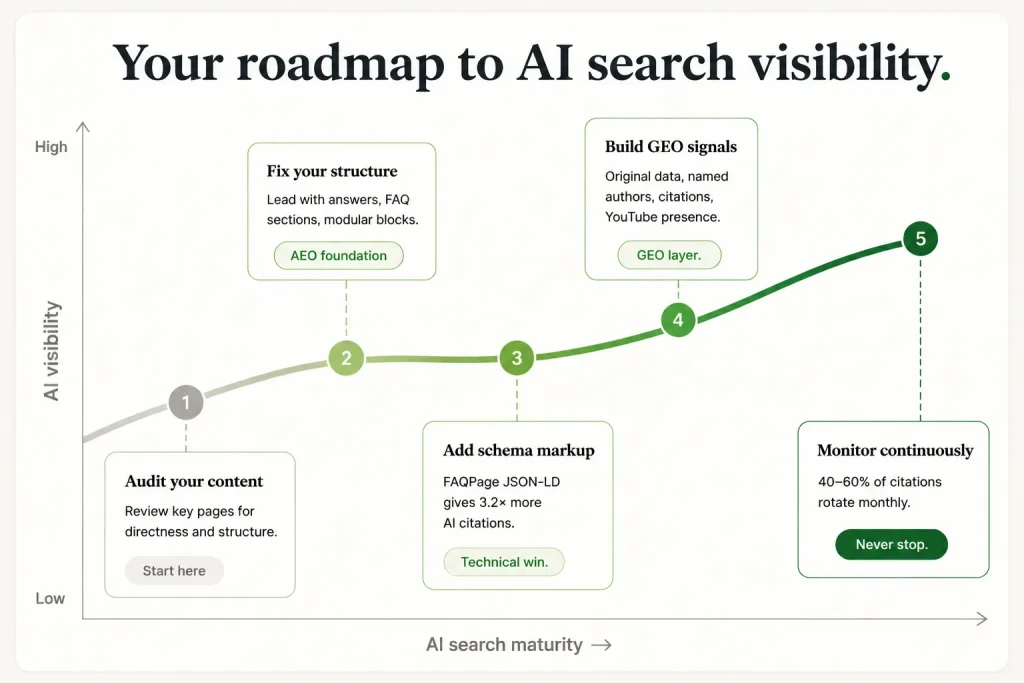
You don’t need to have a perfect system in place today, but you do need to understand these core mechanics. The earlier you start, the faster that compounding effect begins working for you rather than against you.
Frequently Asked Questions
1. What is the difference between AEO and GEO?
AEO gets your content selected as a direct answer to a specific question. GEO ensures your brand stays in the broader conversation when AI synthesizes multi-source responses. AEO answers the question. GEO influences the decision.
2. Do AEO and GEO replace SEO?
They do not. SEO remains the foundation. AI retrieval systems still depend on crawlable, indexable, authoritative websites. AEO and GEO build on top of a solid SEO foundation rather than replacing it.
3. Can smaller brands compete in AI search?
Yes. The Princeton and Georgia Tech research found that smaller, lower-ranked sites saw some of the biggest gains from GEO optimization. Topical clarity and well-structured content regularly outperform generic content from larger, higher-authority domains.
Between 40% and 60% of cited sources change month to month across major AI platforms. Unlike traditional search rankings, AI visibility requires continuous monitoring rather than a one-time optimization effort.
5. Where should I start?
Audit your most important pages for directness and structure. Add FAQ sections. Implement FAQPage schema in JSON-LD format. Then set up monitoring to track where your brand appears in AI-generated answers. These steps cost time rather than budget and produce measurable improvements quickly

About Author
Nazmul HasanNazmul Hasan is a Dhaka-based SEO expert and AI search strategist with over eight years of experience scaling organic growth for global brands. Currently the Head of SEO at Notionhive, he bridges computer science with advanced LLM and generative engine optimization to drive sustainable, human-centric results for diverse industries.