If you're involved in web development or managing any kind of database-driven application, you've likely heard the term SQL Injection (SQLi) before.
But do you truly understand how dangerous this vulnerability is?
SQL Injection is one of the most common and damaging web security risks that websites face today.
Attackers exploit the weaknesses in a website’s database queries to get unauthorized access to sensitive information. Their actions can cause serious harm to businesses and users!
In this blog, I'll break down SQL Injection, explain how it works, and provide real-life attack examples. Most importantly, we'll walk you through effective strategies for preventing these kinds of attacks in your applications.
What is SQL Injection?
SQL injection is a security flaw that lets attackers alter an application’s SQL queries. The vulnerability happens when an application doesn’t properly validate or sanitize user input before including it in SQL queries.
Attackers deceive the database into carrying out unwanted commands by inserting malicious SQL code into input fields.
For instance, an attacker may enter SQL code into a form field designed for username input. When an application does not check user input properly, the database runs the harmful code as part of the query.
This allows attackers to access sensitive data without permission.
How SQL Injection Works
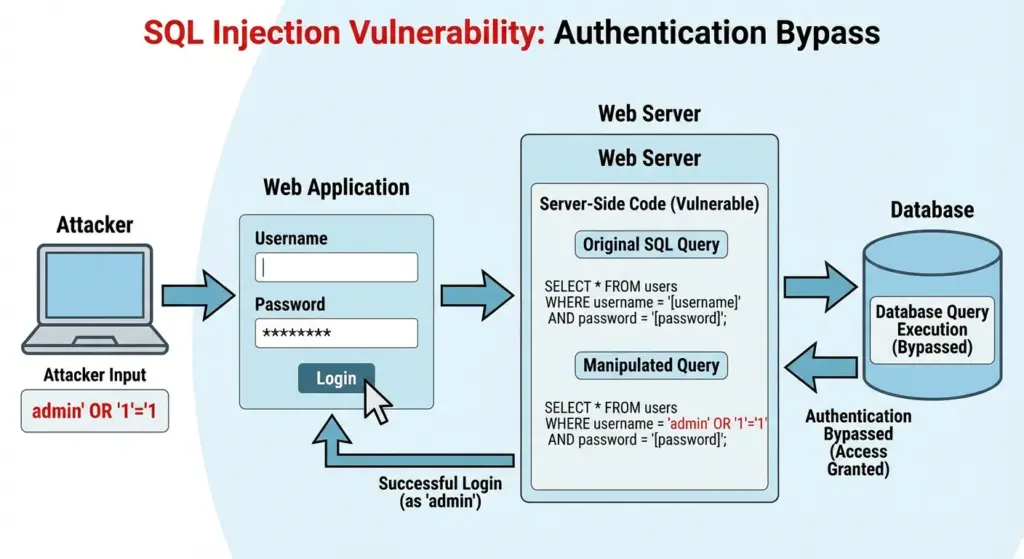
So, at the core, SQL injection exploits the improper handling of user input in SQL queries. Here’s an example to make things clear:
- Imagine a web application has a login form with fields for "username" and "password".
- The application constructs an SQL query like this to authenticate users:
SELECT * FROM users WHERE username = '[user_input]' AND password = '[user_input]';- If the application doesn’t sanitize the input, an attacker might enter the following for the "username" field:
admin' OR '1'='1- The SQL query would then look like this:
SELECT * FROM users WHERE username = 'admin' OR '1'='1' AND password = '[user_input]';- Since '1'='1' is always true, the query would bypass the authentication check, logging the attacker in as the first user (in this case, the admin) without needing to know the password.
This example shows how SQL injection can exploit vulnerabilities in an application’s input validation, allowing attackers to manipulate database queries for malicious purposes.
Common Targets for SQL Injection
SQL injection attacks typically target user input fields that interact with the database. These may include:
- Login forms: The most common target, where attackers try to bypass authentication.
- Search bars: Attackers may inject code to retrieve or modify information stored in the database.
- Contact forms: Input fields that interact with the backend database can be exploited to modify or view sensitive data.
- URL parameters: If an application constructs queries using URL parameters, attackers can modify them to alter database behavior.
Real-Life Examples of SQL Injection Attacks
To truly understand the severity of SQL injection, it’s helpful to look at real-world examples. These incidents highlight just how damaging an SQL injection attack can be, especially when organizations fail to properly secure their web applications.
Example 1: The Heartland Payment Systems Breach (2008)
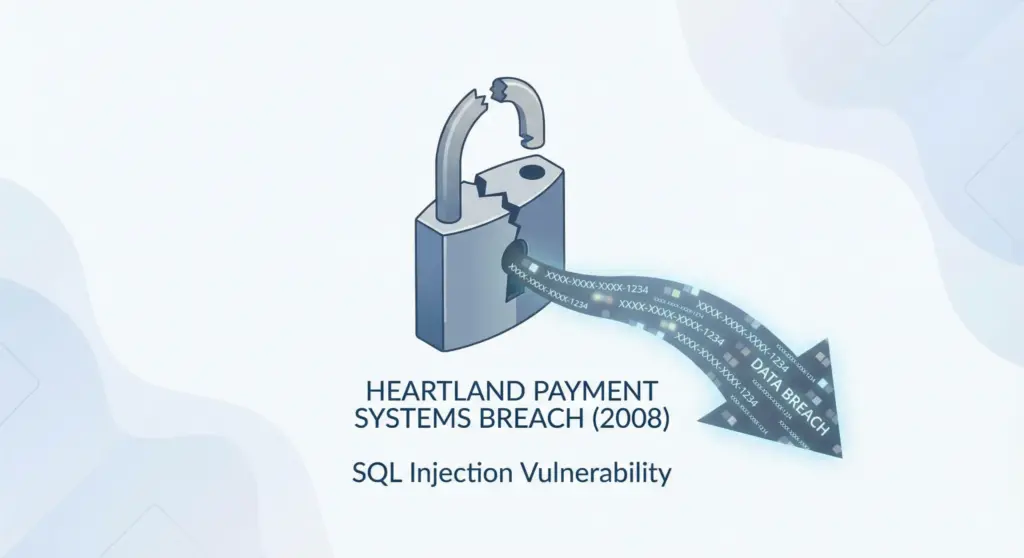
In 2008, Heartland Payment Systems, a leading payment processing corporation, suffered one of the largest data breaches in history. Attackers used SQL injection to exploit vulnerabilities in the company’s network.
They gained access to sensitive card data by injecting malicious SQL code into an insecure application.
As a result, the attackers were able to siphon off over 100 million credit card numbers, making this breach one of the largest known credit card thefts in history.
The breach not only caused financial damage but also severely damaged the company’s reputation.
Example 2: The Sony PlayStation Network Hack (2011)

In 2011, Sony’s PlayStation Network (PSN), which provided online gaming services for millions of users, was compromised by attackers. The infringement happened due to a vulnerability in one of PSN’s web applications, which was susceptible to SQL injection.
By exploiting the vulnerability, attackers accessed 77 million accounts, including users' personal information, credit card details, and other sensitive data. Sony faced massive financial and reputational losses as a result of the attack.
The Impact of SQL Injection Attacks
The consequences of a successful SQL injection attack can be severe and far-reaching. Here's a closer look at how such attacks can affect businesses and their customers.
1. Data Breaches
SQL injection can lead to massive data breaches, exposing sensitive information such as usernames, passwords, email addresses, financial details, and more.
If malicious actors access this data, it can be sold on the dark web or used for identity stealing, fraud, or other criminal activities.
2. Financial Loss
SQL injection attacks can result in direct financial losses. Attackers may gain access to payment processing systems, steal funds, or manipulate transactions.
In some cases, the attackers may even create fake transactions or transfer money without authorization.
In some instances, businesses may be forced to compensate affected customers, pay fines for non-compliance with security regulations (such as GDPR or PCI DSS), and cover the costs of incident response and security fixes.
3. Reputation Damage
Beyond the financial implications, SQL injection attacks often cause lasting damage to a company’s reputation.
Customers lose trust in companies that experience significant data breaches, especially when personal or financial information is exposed. In some cases, companies may face legal action from affected users, further damaging their public image.
4. Legal and Regulatory Consequences
If you fail to secure sensitive data , them it can lead to lawful and regulatory consequences. Many industries have strict regulations surrounding the protection of user data.
Violating these regulations due to an SQL injection breach can result in hefty fines and legal action.
For instance, under regulations like the General Data Protection Regulation (GDPR) in the EU, companies can face severe fines if they fail to protect user data from exposure. This further emphasizes the need to protect web applications from SQL injection vulnerabilities.
Types of SQL Injection Attacks
Understanding the different kinds of SQL injection attacks will help you better protect your web applications.
Here’s a breakdown of some common forms of SQL injection:
1. Classic SQL Injection
Classic SQL injection occurs when an attacker directly injects malicious SQL code into a vulnerable input field. This is the simplest form of SQL injection, where attackers manipulate the SQL query by adding commands like OR 1=1.
2. Blind SQL Injection
In blind SQL injection, attackers can’t directly see the output of their injected queries. However, they can still infer information about the database based on how the application responds to certain inputs.
For example, attackers might test different conditions (e.g., "does this query return true?") and use response times or error messages to infer the database’s structure.
3. Time-Based Blind SQL Injection
This is a specific type of blind SQL injection where attackers use delays to infer information. For example, an attacker might add a condition to the query that forces the server to wait (using SLEEP() in MySQL).
If the server responds after a delay, the attacker knows that their injected query caused the server to execute a certain command.
4. Error-Based SQL Injection
In error-based SQL injection, attackers deliberately trigger errors in the database to expose information about its structure.
The application might reveal valuable details about the database schema or table names through these error messages, which attackers can then exploit.
How to Prevent SQL Injection
Now that we understand the impact of SQL injection, let’s discuss how to prevent these attacks from happening in the first place. Prevention is key, and here are the most effective strategies to mitigate SQL injection risks.
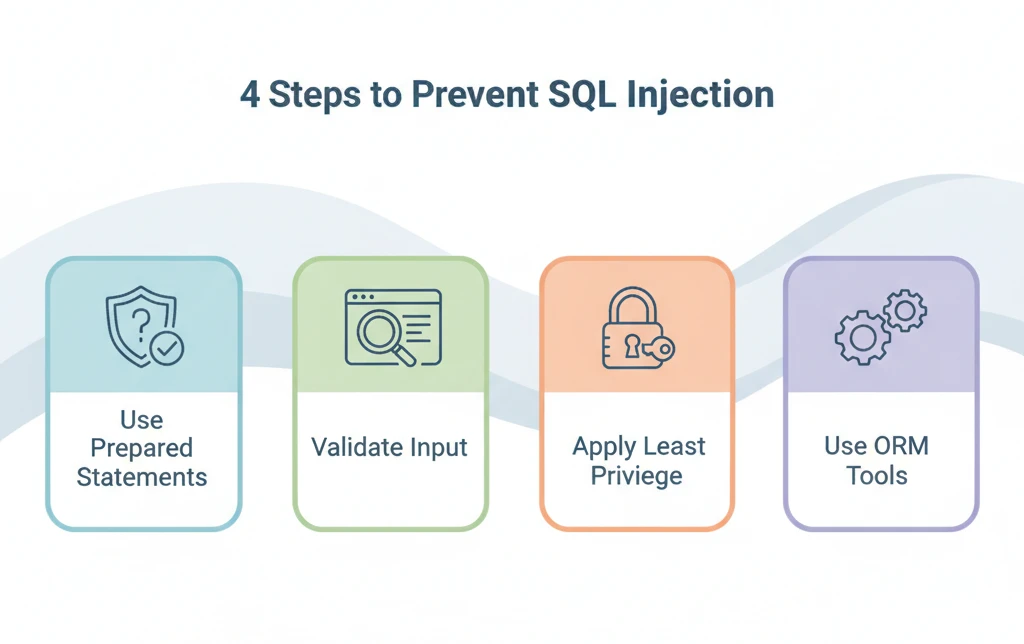
1. Use Ready Statements and Parameterized Queries
Prepared statements and parameterized queries are the best ways to stop SQL injection.
These methods ensure that user inputs are treated as data, not executable code. With prepared statements, the SQL query structure is defined first, and user input is passed separately, eliminating the risk of injection.
Here’s a simple example of a parameterized query in PHP:
$stmt = $pdo->prepare("SELECT * FROM users WHERE username = :username AND password = :password");

$stmt->bindParam(':username', $username);

$stmt->bindParam(':password', $password);

$stmt->execute();
2. Input Validation and Sanitization
Always validate and sanitize user inputs before passing them into your queries. Ensure that input fields accept only the expected types of data (e.g., numeric values, email addresses, etc.) and reject anything suspicious.
For example, if you're accepting an email address, you should validate that the input matches a valid email format and sanitize it to prevent special characters from being interpreted as code.
3. Least Privilege Principle
The least privilege principle is a key strategy in securing your database. Essentially, each part of your application, including the database, should have the minimum access rights necessary to perform its task.
If an attacker exploits an SQL injection vulnerability, the damage they can cause is limited if the account has only restricted access.
For instance, the account used by the web application to interact with the database should not have administrative privileges. It should only perform the specific tasks needed by the application, such as reading and writing to certain tables.
Example:
- Use read-only accounts for areas where only data retrieval is needed.
- Restrict access to tables that the web application does not need.
This helps minimize the potential damage if SQL injection attacks occur.
4. Use ORM (Object-Relational Mapping) Tools
Object-Relational Mapping (ORM) tools abstract the raw SQL queries from your code, allowing you to interact with the database using objects and methods instead of writing raw SQL. Many ORMs automatically handle common security vulnerabilities, including SQL injection, by using parameterized queries behind the scenes.
Some popular ORM tools include:
- Hibernate (Java)
- Entity Framework (C#)
- ActiveRecord (Ruby on Rails)
Using ORMs can significantly reduce the chances of introducing SQL injection vulnerabilities, especially for developers who may not be as familiar with secure SQL query practices.
5. Error Handling
Another often-overlooked part of security is error handling. When an application encounters a database error, the message can reveal details about the database, queries, or the application itself.
Attackers can use this information to refine their attack and learn more about your system. For example, an error message like:
ERROR: You have an error in your SQL syntax; check the manual that corresponds to your MySQL server version for the right syntax to use near 'AND 1=1' at line 1This message indicates an SQL syntax issue in the query, which attackers can exploit to craft their next attack attempt.
How to Handle Errors Securely:
- Don’t display raw error messages to end users. Customize error pages so that they don’t reveal sensitive information about the server or database.
- Log errors securely. Record detailed error logs on the server side, but ensure that only administrators have access to these logs.
- Use generic error messages for end-users, such as “An error occurred. Please try again later.”
Tools to Detect and Prevent SQL Injection
While preventing SQL injection through secure coding practices is essential, it’s also important to use tools to detect potential vulnerabilities in your applications.
Here are a few tools that can help you identify SQL injection weaknesses and secure your applications:
1. SQLMap
SQLMap is one of the most popular and powerful open-source penetration testing tools for automating the detection and exploitation of SQL injection flaws.
It supports various SQL injection techniques, including blind, time-based, and error-based SQL injection.
SQLMap can be used to:
- Scan for SQL injection vulnerabilities in web applications.
- Automate the exploitation of SQL injection weaknesses to test the effectiveness of defences.
- Enumerate database tables and columns to identify sensitive data.
By running SQLMap against your web application in a controlled environment, you can discover and address SQL injection vulnerabilities before attackers exploit them.
2. OWASP ZAP (Zed Attack Proxy)
OWASP ZAP is a free, open-source security testing tool maintained by the OWASP (Open Web Application Security Project). ZAP can scan your web applications for various vulnerabilities, including SQL injection.
It provides an easy-to-use interface and supports automated security scanning, manual penetration testing, and passive scanning.
How OWASP ZAP Helps:
- Automated Scanning: ZAP can automatically detect SQL injection vulnerabilities by analyzing your web traffic.
- Real-time Monitoring: You can run it during regular testing or use it for active attacks during penetration testing.
- Free and Open Source: ZAP is a community-driven tool and has a wealth of documentation and support from security professionals.
3. Burp Suite
Burp Suite is another well-known tool to perform web application security testing. It includes a range of features, such as a vulnerability scanner, an intruder for automating attacks, and a repeater for sending modified requests.
It is beneficial for manual testing and can identify SQL injection vulnerabilities during active testing.
Burp Suite’s Intruder tool can be configured to send payloads designed to test for SQL injection, and the Scanner tool can automatically find issues in your web application’s endpoints.
The Role of Developers in Preventing SQL Injection
Developers write the code; it’s their responsibility to implement security best practices and ensure that SQL injection vulnerabilities are never introduced in the first place.
Here are a few key points that developers should focus on to prevent SQL injection:
Best Practices for Developers
- Use Secure Coding Practices: Always write code with security in mind. Follow best practices like input validation, using parameterized queries, and avoiding dynamic SQL.
- Keep Libraries and Frameworks Updated: Make sure the application's libraries and frameworks are recent and free of known vulnerabilities. This is especially important when building modern web apps.
- Regularly Audit Your Code: Conduct regular code reviews and security audits to ensure that no new vulnerabilities have been introduced. Automatic static analysis tools can help identify insecure code.
- Educate and Train Development Teams: SQL injection vulnerabilities often occur because developers aren’t aware of secure coding practices. Make sure the development team is trained and stays up to date on current security threats.
Education and Awareness
Developers need continuous education on the latest security practices. Tools like the OWASP Top 10 and secure coding workshops can help teams stay ahead of emerging threats.
Conclusion
SQL injection attacks are a serious risk. They can cause data breaches, financial loss, and lasting damage to a company’s reputation. When you understand how these attacks work and how to prevent them, you can better protect your applications and user data.
Start with secure coding practices such as prepared statements and input validation. Limit database access where possible.
If you're developing custom web applications, security should always be a top priority. By taking proactive steps to secure your applications, you'll minimize the risk of SQL injection and keep your users and their data safe.
Some Common Questions Answered
- What is SQL Injection?
SQL Injection is a sort of attack where an attacker put malicious SQL code into a web application's input fields to manipulate the database and gain unauthorized access. - How does SQL Injection work?
It works by exploiting vulnerabilities in how an application handles user input in SQL queries, allowing attackers to execute unintended database commands. - Can SQL Injection be prevented?
Yes, SQL injection can be prevented using techniques such as parameterized queries, input validation, and least-privilege principles. - Is SQL Injection still a threat in 2023?
Absolutely! Despite being well-known, SQL injection remains one of the top risks for many web applications today. - What are the most common types of SQL Injection attacks?
The most common types are classic SQL injection, blind SQL injection, time-based blind SQL injection, and error-based SQL injection. - What tools can I use to detect SQL Injection?
Tools like SQLMap, OWASP ZAP, and Burp Suite are commonly used to detect SQL injection vulnerabilities. - What is Blind SQL Injection?
Blind SQL Injection is when attackers can't directly see the output of their injected query, but they infer the result based on the application’s behavior. - Why is using parameterized queries important?
SQL injection attacks are prevented by parameterized queries, which guarantee that user input is handled as data rather than executable code. - How can I prevent SQL injection in my applications?
Use parameterized queries, validate user input, implement the least-privilege principle, and regularly audit your code for security vulnerabilities. - Can an SQL Injection attack affect my entire website?Yes, depending on the attack's scope, SQL injection can give attackers access to your entire database and cause widespread damage to your website or service.

About Author
Tanzim Sarwar TazTanzim Sarwar Taz is a content writer with 7+ years of experience creating in-depth content on SEO, technology, web development trends, and AI-driven search. His work focuses on emerging topics such as AEO, GEO, search experience optimization, artificial intelligence, and modern web technologies, delivering practical insights backed by research and industry developments.